Solar Incentives in Orleans County, NY
Orleans County is orchard country on the Lake Ontario shore — open land, real snow, and modest household budgets.
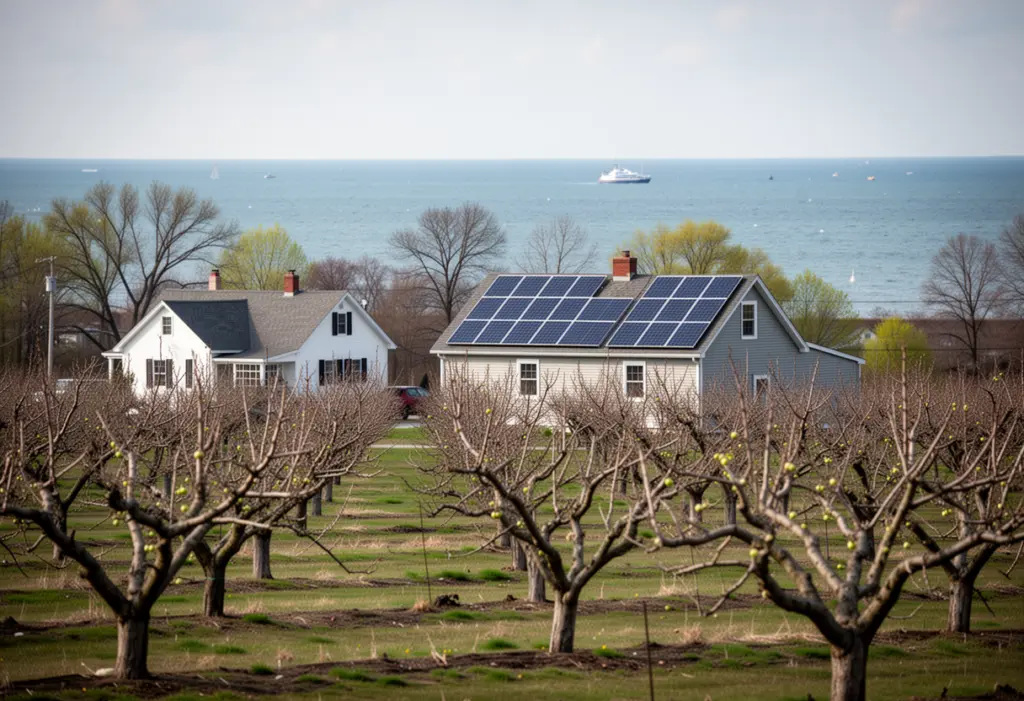
Orleans County runs along the Lake Ontario shore between Rochester and Niagara — Albion, Medina, Holley, Lyndonville, Kendall. ZIP codes here begin 144 and 140. It is fruit-belt farmland, thinly populated, and among the more affordable housing markets in the state.
Open ground is an advantage
The lake plain is flat and largely cleared, which means a clear southern horizon on a great many properties — the condition most New York solar articles are working around. Shading is less often the binding constraint here than almost anywhere in the state.
That makes ground mounts straightforward: orientation and tilt chosen freely, roof age irrelevant, maintenance and snow clearing at ground level. Ask for one alongside the roof option, and on open ground ask what wind load the structure is specified for as well as the snow load.
Lake-effect snow
The Ontario shore takes real lake-effect snow. Ask what load the racking is specified for and who verified the roof can carry it; ask whether snow guards are needed where the array discharges; and ask what snow-cover assumption is in the production estimate, because a model without one overstates the annual figure.
Panels shed faster than the shingles around them, and the lost days fall in December and January, which net metering covers from the summer surplus.
Roof age is the gate for most households
In a market with modest house values, roof condition decides whether a project makes sense now rather than in a few years. Under roughly ten years of shingle life left means the roof comes first — removing and reinstalling an array later costs considerably more, and that second cost lands on a household that budgeted once.
Get the roof assessed by someone who is not selling you panels.
National Grid
The Customer Benefit Contribution is $0.97 per kW-month of DC system size for 2026, the lowest of the major New York utilities: about $4.85 a month on a 5 kW system, roughly $58 a year. Billed on capacity regardless of production and recalculated annually. Phase One net metering credits exports at the full retail rate and holds for 20 years.
Service on the county edges is not uniform, so confirm from your own bill.
Fruit farms: two decisions
A project to offset the farm’s own consumption — cold storage, packing, irrigation — sits on the business side of the tax code, where the investment tax credit and depreciation did not follow the residential credit into repeal at the end of 2025. Get interval data rather than bill totals; for a commercial account the shape of the load is the analysis. That is an accountant’s question with your own figures.
Leasing ground to a developer is separate and long-term: decommissioning security, rent escalation, access routes, drainage and tile, the option period and agricultural assessment matter more than the headline rent. Use your own attorney.
2026 incentives
The 30% federal residential credit is gone. Section 25D was terminated for expenditures made after 31 December 2025, with an expenditure treated as made when the original installation is completed. On a tight budget a quote still showing it overstates the net cost by thousands.
Still available:
- New York’s 25% credit, capped at $5,000, on Form IT-255 — non-refundable but carried forward five years, which is the detail that matters where tax liability is modest.
- The state sales tax exemption on residential solar equipment, which covers the 4% state tax only: Orleans County still charges its own 4% local sales tax on it (Publication 718-S, Part 1).
- RPTL 487, the 15-year property tax exemption, where your town or village, the county and your school district have not opted out. The exemption needs a system built before 1 January 2030 and form RP-487 filed with your assessor by the taxable status date (March 1 in most towns; your assessor confirms yours).
Not available for homes now: NY-Sun. As of September 2026 NYSERDA has no open NY-Sun block for homes in any utility territory. In its Upstate region the last standard residential block (Block 14, $0.15/W), for NYSEG, RG&E and National Grid territory, closed on 17 December 2025, and the Affordable Solar block for lower-income households closed on 9 March 2026. Check NYSERDA’s NY-Sun dashboard for a new one before counting on it.
Frequently Asked Questions
Is Orleans County good ground for solar?
The lake plain is flat and largely cleared, so a clear southern horizon is common and shading is less often the binding constraint than almost anywhere in New York. That makes ground mounts straightforward.
Does lake-effect snow affect solar on the Ontario shore?
It requires racking specified for the local load, roof structure verification, snow guards where the array discharges, and a snow-cover assumption in the production estimate. Panels shed faster than the roof around them and the lost days fall in the weakest months.
What extra help exists for lower-income Orleans County households?
None from NY-Sun right now. NYSERDA's Affordable Solar incentive for lower-income households closed in its Upstate region on 9 March 2026, and as of September 2026 no NY-Sun block for homes is open in any utility territory. What NYSERDA does offer now is Statewide Solar for All: households enrolled in their utility's Energy Assistance Program (EAP) get a monthly community-solar credit on their electric bill, with no upfront cost or fees, and enrolment in EAP enrolls you automatically. On a modest tax bill, the state credit's five-year carry-forward also helps; check NYSERDA's NY-Sun dashboard for a new block.
How should a fruit farm analyse a solar proposal?
From interval data rather than bill totals, because on a commercial account the shape of the load is the analysis. The tax treatment sits on the business side, where the investment tax credit and depreciation survive, and belongs with your accountant.
This article is general information, not tax, legal or financial advice. Incentive amounts, eligibility rules and deadlines change and depend on your utility, your tax situation and your property. Confirm current terms with NYSERDA, your utility and a qualified tax professional before making a decision.
NY Solar Incentives
Independent New York solar research. We summarise NYSERDA, NY-Sun and federal programme rules from published sources and state plainly when a figure is an estimate. We are not a government agency and do not sell equipment.
Run the arithmetic on your own system
Check the dated program table and your arrangement before counting an incentive. Standard residential NY-Sun blocks are closed; Long Island Affordable Solar has a conditional income-verification route. The NY credit depends on qualified costs and tax liability, while the NYC abatement reduces future property-tax bills. The estimator keeps those timings separate.