Solar Panel Installation in Riverhead, NY
Riverhead is the one part of Long Island with real open land, which makes ground-mounted solar a genuine option rather than a theoretical one.
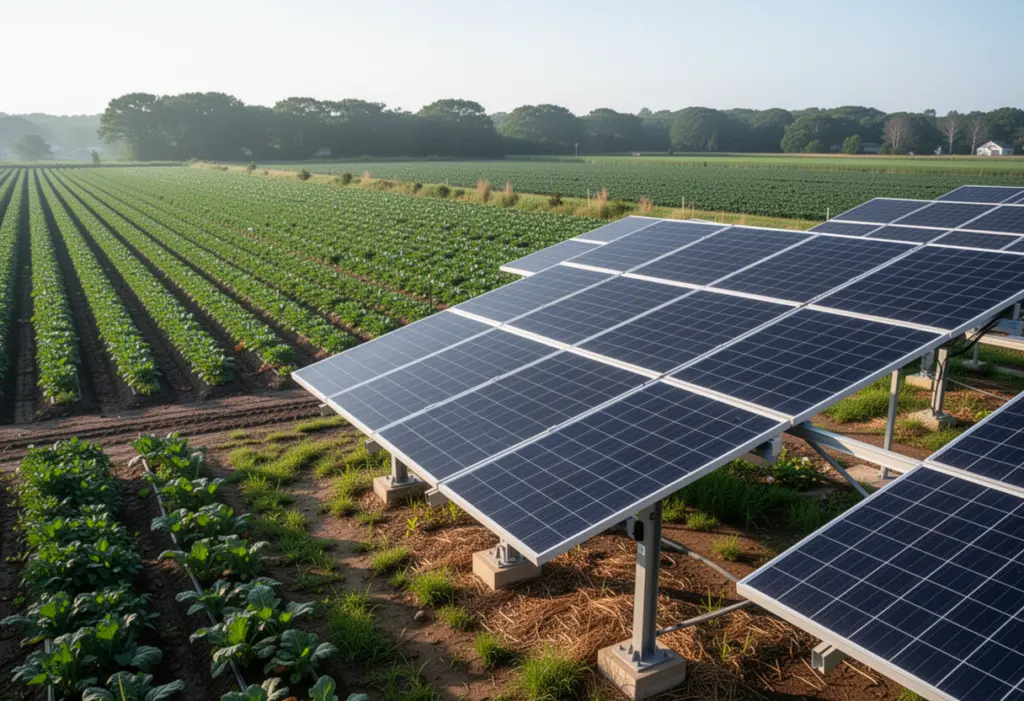
Riverhead sits at the fork of eastern Long Island — the town centre, Aquebogue, Jamesport, Wading River, Calverton and the agricultural land that separates the North and South Forks. ZIP codes here begin 119. It is the one part of Long Island where a solar conversation can realistically start with a question nobody asks in Nassau: do you want it on the roof at all?
Ground mounts are a real option here
Riverhead has open land in a way the rest of Long Island does not. Where a property has the space, a ground-mounted array removes several constraints at once:
- Orientation and tilt are yours to choose rather than dictated by the roof, so the array can be aimed exactly where it should be.
- Roof age becomes irrelevant. No re-roofing question, no removal and reinstallation later.
- Shading is often avoidable by siting rather than by compromise.
- Access for maintenance is from the ground, which also means snow can be cleared safely if you ever need to.
It is not free — there is trenching, a foundation or ground-screw system, and its own permitting — but on a property with land it is often closer in cost to a roof array than people expect. Ask for both to be quoted rather than one instead of the other.
Agricultural land is a separate conversation
If you farm here, there are two entirely different decisions: installing solar to offset the farm’s own consumption, and leasing ground to a developer. They have different economics and different risks.
For the farm’s own load, the business side of the tax code is the relevant one, and it did not follow the residential credit into repeal — that is an accountant’s question with your own figures. For a land lease, term length, decommissioning security, access routes, drainage and agricultural assessment consequences all matter more than the headline rent. Take your own attorney rather than the developer’s paperwork.
The residential sequence
- Twelve months of PSEG Long Island usage, shading assessment, roof or site condition.
- Interconnection application to PSEG Long Island, before installation.
- Building permit from the Town of Riverhead.
- Installation, then electrical inspection.
- Certificate to PSEG Long Island, meter exchange, permission to operate. Do not run the system before PTO.
A ground mount adds its own siting and setback questions at the permit stage, so ask early what the town requires.
Coastal conditions
Wind load is the design factor, more demanding closer to either shore. Salt exposure affects mounting hardware and outdoor enclosure ratings. Both apply to ground mounts as well as roofs.
The utility numbers
Phase One net metering credits exports at the full retail rate, held for 20 years from interconnection — worth more here than upstate because Long Island retail rates are high.
The Customer Benefit Contribution is $1.13 per kW-month of DC system size for LIPA in 2026 — about $9.04 a month on an 8 kW system. Because ground-mounted systems are frequently larger than roof arrays, this is worth calculating on the actual proposed size: a 15 kW ground mount pays about $16.95 a month, roughly $203 a year. It is billed on capacity regardless of production and recalculated annually.
2026 incentives
The 30% federal residential credit ended for expenditures made after 31 December 2025, with the expenditure treated as made when the original installation is completed.
Still available: New York’s 25% credit capped at $5,000 on Form IT-255; the state sales tax exemption; and RPTL 487’s 15-year property tax exemption where the town, the county and your school district have not opted out, claimed by filing form RP-487 with the assessor by the taxable status date.
NY-Sun is not on that list. As of September 2026 NYSERDA has no open NY-Sun block for homes in any utility territory, and on Long Island the last standard residential block closed in April 2016, so a Riverhead quote should not show a NY-Sun discount unless the household is approved for Affordable Solar. NYSERDA’s April 2026 NY-Sun Program Manual still lists one home incentive on Long Island that is not tied to a block: the Affordable Solar Residential Incentive of $0.40 per watt for income-qualified homeowners, paid to a participating NY-Sun contractor, who must pass it on in your contract. Ask the contractor to confirm funding is still available. Check NYSERDA’s NY-Sun dashboard for a new one.
Frequently Asked Questions
Is a ground-mounted solar array practical in Riverhead?
More than anywhere else on Long Island, because there is open land. A ground mount lets you choose orientation and tilt, removes the roof-age question entirely, often avoids shading by siting, and allows ground-level maintenance access.
How much does the CBC charge cost on a larger ground-mounted system?
It is billed on DC system size at $1.13 per kW-month for LIPA in 2026, so a 15 kW ground mount pays about $16.95 a month, roughly $203 a year — proportionally more than a smaller roof array, which is worth calculating on the actual proposed size.
What should a North Fork farmer check before leasing land for solar?
Term length and renewal control, decommissioning security backed by a bond or escrow, the array footprint and access route, effects on drainage and tile, rent escalation, and consequences for agricultural assessment. Use your own attorney.
Do coastal conditions affect a ground-mounted array?
Yes. Wind load is the dominant design factor and applies to ground mounts as well as roofs, and salt exposure near either shore affects mounting hardware and the enclosure ratings on outdoor equipment.
This article is general information, not tax, legal or financial advice. Incentive amounts, eligibility rules and deadlines change and depend on your utility, your tax situation and your property. Confirm current terms with NYSERDA, your utility and a qualified tax professional before making a decision.
NY Solar Incentives
Independent New York solar research. We summarise NYSERDA, NY-Sun and federal programme rules from published sources and state plainly when a figure is an estimate. We are not a government agency and do not sell equipment.
Run the arithmetic on your own system
Check the dated program table and your arrangement before counting an incentive. Standard residential NY-Sun blocks are closed; Long Island Affordable Solar has a conditional income-verification route. The NY credit depends on qualified costs and tax liability, while the NYC abatement reduces future property-tax bills. The estimator keeps those timings separate.