Solar Panel Installation in Islip, NY
Islip covers a dense stretch of Suffolk's south shore. Here is what its permitting, its coastal exposure and its housing stock mean for a solar project.
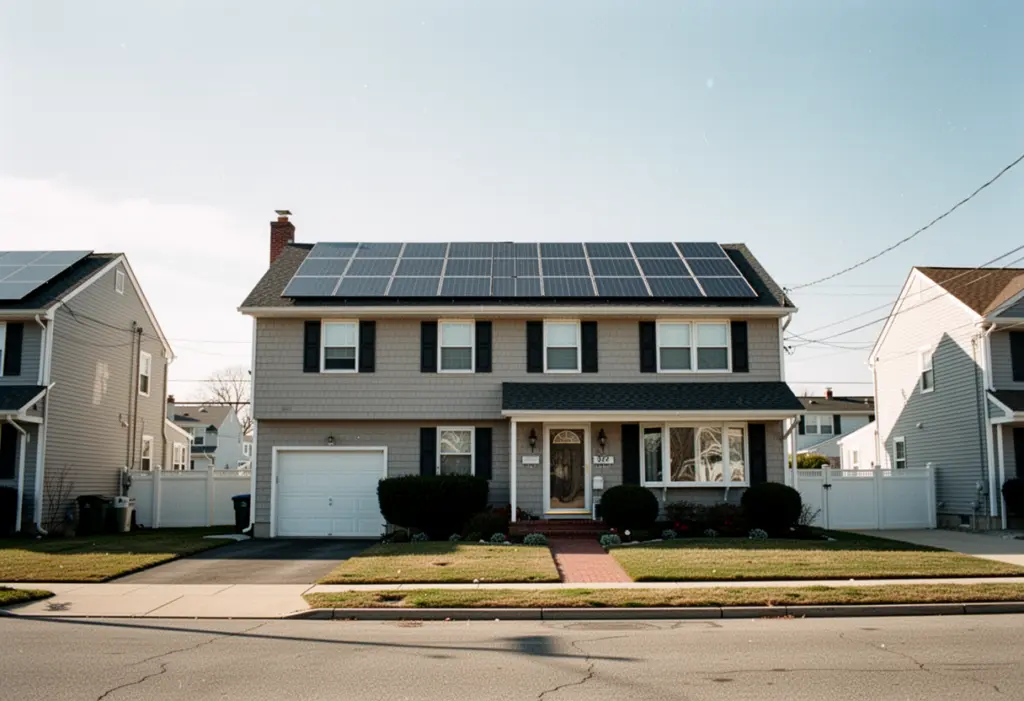
The Town of Islip runs along Suffolk County’s south shore — Bay Shore, Central Islip, Brentwood, Bohemia, Sayville, West Islip, East Islip, Holbrook, Ronkonkoma, Islandia and the barrier beach communities. ZIP codes here begin 117. It is flat, densely developed, and close enough to the water that wind load rather than snow load drives the engineering.
The sequence
- Site assessment — twelve months of PSEG Long Island usage, an on-site shading assessment, roof condition and structure.
- Interconnection application to PSEG Long Island, before installation.
- Building permit from the Town of Islip, or from your incorporated village — Brightwaters, Islandia, Ocean Beach, Saltaire and others issue their own.
- Installation, then electrical inspection.
- Certificate to PSEG Long Island, meter exchange, permission to operate. The system may not run before PTO.
Ask which authority is issuing your permit and what it is currently running at. Islip is a high-volume town for solar and its turnaround varies through the year — autumn is the busiest period, because everyone wants to be finished before winter.
South shore engineering
Wind load is the design factor. Racking and attachment must be specified for the local wind zone, and Islip’s proximity to the Great South Bay and the ocean makes that specification more demanding than inland Suffolk. Ask what load the system is designed to and who confirmed it.
Flood zones. Parts of the town sit in mapped flood zones, and where the inverter, disconnects and any battery are mounted becomes a genuine design question rather than a detail. Raise it specifically if your property is affected.
Salt exposure near the water affects mounting hardware and the enclosure ratings on outdoor equipment.
Roofs and shading
Islip’s housing is largely post-war — ranches, split-levels, Capes — on modest lots. Usable roof area is often the constraint rather than consumption, and houses sit close enough together that a neighbour’s roofline shades at the low winter sun angle. Both are reasons to insist on an on-site shading assessment and to ask what is limiting the array size.
Roof age is the other gate: under roughly ten years of shingle life left means re-roof first, because removing and reinstalling an array later costs considerably more than mounting on a bare roof.
The utility numbers
Phase One net metering credits exports at the full retail rate and holds for 20 years from interconnection. The Customer Benefit Contribution is $1.13 per kW-month of DC system size for LIPA in 2026 — about $9.04 a month on an 8 kW system, roughly $108 a year, billed on capacity regardless of production and recalculated annually. Mass-market LIPA projects cannot opt into the Value Stack.
2026 incentives
The 30% federal credit is gone. Section 25D was terminated for expenditures made after 31 December 2025, and an expenditure counts as made when the original installation is completed. A quote still showing a 30% federal line is overstating your net cost by thousands.
Still available: New York’s 25% credit capped at $5,000 on Form IT-255, which reaches leases and PPAs of ten years or more as well as purchases; the state sales tax exemption; and RPTL 487’s 15-year property tax exemption where the town, your village, the county and your school district have not opted out, claimed by filing form RP-487 with the assessor by the taxable status date.
NY-Sun is not on that list, apart from one income-qualified incentive. As of September 2026 NYSERDA has no open NY-Sun block for homes in any utility territory, and on Long Island the last standard residential block closed in April 2016. NYSERDA’s April 2026 NY-Sun Program Manual still lists one home incentive on Long Island that is not tied to a block: the Affordable Solar Residential Incentive of $0.40 per watt for income-qualified homeowners, paid to a participating NY-Sun contractor, who must pass it on in your contract. Ask the contractor to confirm funding is still available. An Islip quote should show no other NY-Sun discount; check NYSERDA’s NY-Sun dashboard for a new one.
Frequently Asked Questions
Who issues a solar permit in the Town of Islip?
The town, unless you live in an incorporated village such as Brightwaters, Islandia, Ocean Beach or Saltaire, which issue their own. Islip is a high-volume solar town and its turnaround varies through the year, with autumn the busiest period.
Does a flood zone affect solar installation in Islip?
It affects where the inverter, disconnects and any battery may be mounted, which is a design question rather than a detail on affected south shore properties. Raise it specifically at the quoting stage.
What is the main engineering factor for solar on Long Island's south shore?
Wind load rather than snow load. Racking and attachment must be specified for the local wind zone, and proximity to the bay and ocean makes that more demanding than inland. Salt exposure also affects hardware and outdoor enclosure ratings.
What incentives can an Islip homeowner claim in 2026?
New York's 25% credit capped at $5,000 on Form IT-255, the state sales tax exemption, and RPTL 487 where the relevant authorities have not opted out, if you file form RP-487 with the assessor by the taxable status date. NY-Sun has no open block for homes as of September 2026; on Long Island NYSERDA still lists the income-qualified Affordable Solar incentive ($0.40 per watt), which is not tied to a block and is claimed by a participating NY-Sun contractor. The federal 30% credit ended after 2025.
This article is general information, not tax, legal or financial advice. Incentive amounts, eligibility rules and deadlines change and depend on your utility, your tax situation and your property. Confirm current terms with NYSERDA, your utility and a qualified tax professional before making a decision.
NY Solar Incentives
Independent New York solar research. We summarise NYSERDA, NY-Sun and federal programme rules from published sources and state plainly when a figure is an estimate. We are not a government agency and do not sell equipment.
Run the arithmetic on your own system
Check the dated program table and your arrangement before counting an incentive. Standard residential NY-Sun blocks are closed; Long Island Affordable Solar has a conditional income-verification route. The NY credit depends on qualified costs and tax liability, while the NYC abatement reduces future property-tax bills. The estimator keeps those timings separate.