Solar Panel Installation in Brookhaven, NY
Brookhaven is the largest town in Suffolk and covers wildly different housing. Here is what the installation sequence involves and what it is worth.
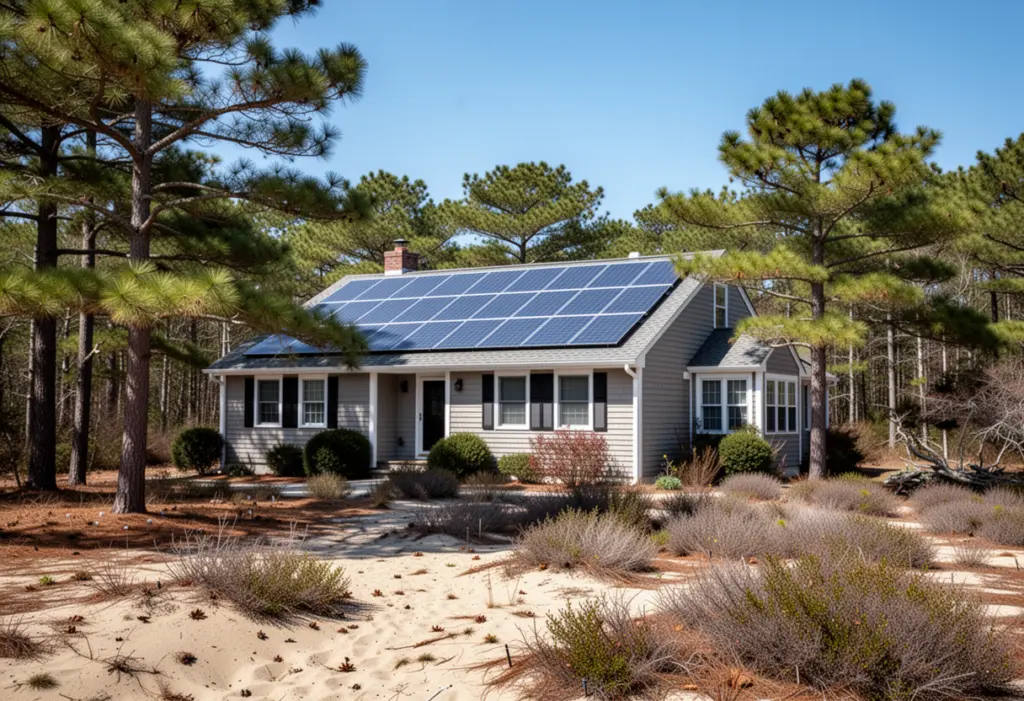
Brookhaven is the largest town in Suffolk County by both area and population, stretching from the middle of Long Island to both shores — Port Jefferson, Patchogue, Medford, Coram, Selden, Farmingville, Shirley, Mastic, Bellport, Miller Place and a great deal more. ZIP codes here begin 117 and 119.
It is also the most varied. A 1960s ranch in Selden and a waterfront house in Old Field are not the same solar project, and a quote built from a template will get one of them wrong.
The sequence
- Site assessment — twelve months of PSEG Long Island usage, an on-site shading assessment, roof condition and structure.
- Interconnection application to PSEG Long Island, before installation.
- Building permit from the Town of Brookhaven, or from your incorporated village — Port Jefferson, Bellport, Patchogue, Old Field, Belle Terre, Poquott, Lake Grove and others issue their own.
- Installation, then electrical inspection.
- Certificate to PSEG Long Island, meter exchange, permission to operate. The system may not run before PTO.
Brookhaven’s size means volume, and volume means the town’s own turnaround is a real variable. Ask your installer what it is currently running at based on their recent Brookhaven projects, and separately what your village is running at if you are in one.
What varies across the town
- Central Brookhaven — Selden, Coram, Farmingville, Medford — is dominated by post-war ranches and Capes on modest lots. Usable roof area is frequently the limit rather than consumption, and pine cover is patchy but real.
- The south shore — Shirley, Mastic, Bellport — is flatter and more exposed, with wind load the dominant design factor and flood-zone considerations for equipment placement on some properties.
- The north shore — Port Jefferson, Miller Place, Setauket — is wooded and hillier, so shading matters more and staging on a sloped lot takes longer.
Wind load and equipment placement
Racking and attachment must be specified for the local wind zone, and near either shore that specification is meaningfully more demanding than inland. On south-shore properties in a flood zone, where the inverter and any battery are mounted is a genuine design question rather than a detail — ask specifically.
PSEG Long Island
Phase One net metering credits exports at the full retail rate and holds for 20 years from interconnection. Long Island retail rates are high, which is what makes the economics work.
The Customer Benefit Contribution is $1.13 per kW-month of DC system size for LIPA in 2026 — about $9.04 a month on an 8 kW system, roughly $108 a year, billed on capacity rather than output and recalculated annually. Mass-market LIPA projects cannot opt into the Value Stack, so net metering is the arrangement.
2026 incentives
The 30% federal residential credit is gone — section 25D was terminated for expenditures made after 31 December 2025, the expenditure being treated as made when the original installation is completed.
Still available: New York’s 25% credit capped at $5,000 on Form IT-255, available on leases and PPAs of ten years or more as well as purchases; the state sales tax exemption; and RPTL 487’s property tax exemption where the town, village, county and school district have not opted out, claimed by filing form RP-487 with the assessor by the taxable status date.
NY-Sun is not on that list, apart from one income-qualified incentive. As of September 2026 NYSERDA has no open NY-Sun block for homes in any utility territory, and on Long Island the last standard residential block closed in April 2016. NYSERDA’s April 2026 NY-Sun Program Manual still lists one home incentive on Long Island that is not tied to a block: the Affordable Solar Residential Incentive of $0.40 per watt for income-qualified homeowners, paid to a participating NY-Sun contractor, who must pass it on in your contract. Ask the contractor to confirm funding is still available. A Brookhaven quote should show no other NY-Sun discount; check NYSERDA’s NY-Sun dashboard for a new one.
If the roof will not take a full system
Common on Brookhaven’s smaller ranch roofs. A partial rooftop array plus a community solar subscription covers the remainder without needing more roof, and community solar subscribers pay no Customer Benefit Contribution at all. Few installers propose the combination, because they sell roofs — it is worth raising yourself.
Frequently Asked Questions
Who issues solar permits in Brookhaven?
The Town of Brookhaven, unless you live in an incorporated village such as Port Jefferson, Bellport, Patchogue, Old Field, Belle Terre or Lake Grove, each of which issues its own with its own turnaround.
Does living in a flood zone affect a solar installation?
It affects where the inverter and any battery can be mounted, which is a genuine design question on some south-shore Brookhaven properties rather than a detail. Ask your installer specifically how equipment placement handles it.
Why is my Brookhaven solar system smaller than my usage?
Usable roof area is frequently the limit on the post-war ranches and Capes common in central Brookhaven. A partial rooftop array combined with a community solar subscription can cover the remainder without needing more roof.
What wind load should Long Island solar racking be designed for?
The local wind zone, which is more demanding near either shore than inland. It is a fair and specific question for any installer: what load is this system designed to, and who confirmed it.
This article is general information, not tax, legal or financial advice. Incentive amounts, eligibility rules and deadlines change and depend on your utility, your tax situation and your property. Confirm current terms with NYSERDA, your utility and a qualified tax professional before making a decision.
NY Solar Incentives
Independent New York solar research. We summarise NYSERDA, NY-Sun and federal programme rules from published sources and state plainly when a figure is an estimate. We are not a government agency and do not sell equipment.
Run the arithmetic on your own system
Check the dated program table and your arrangement before counting an incentive. Standard residential NY-Sun blocks are closed; Long Island Affordable Solar has a conditional income-verification route. The NY credit depends on qualified costs and tax liability, while the NYC abatement reduces future property-tax bills. The estimator keeps those timings separate.