Community Solar for NYSEG Customers
NYSEG's territory is full of shaded, wooded and rural properties where a roof array will not work. Community solar is the answer that needs no roof.
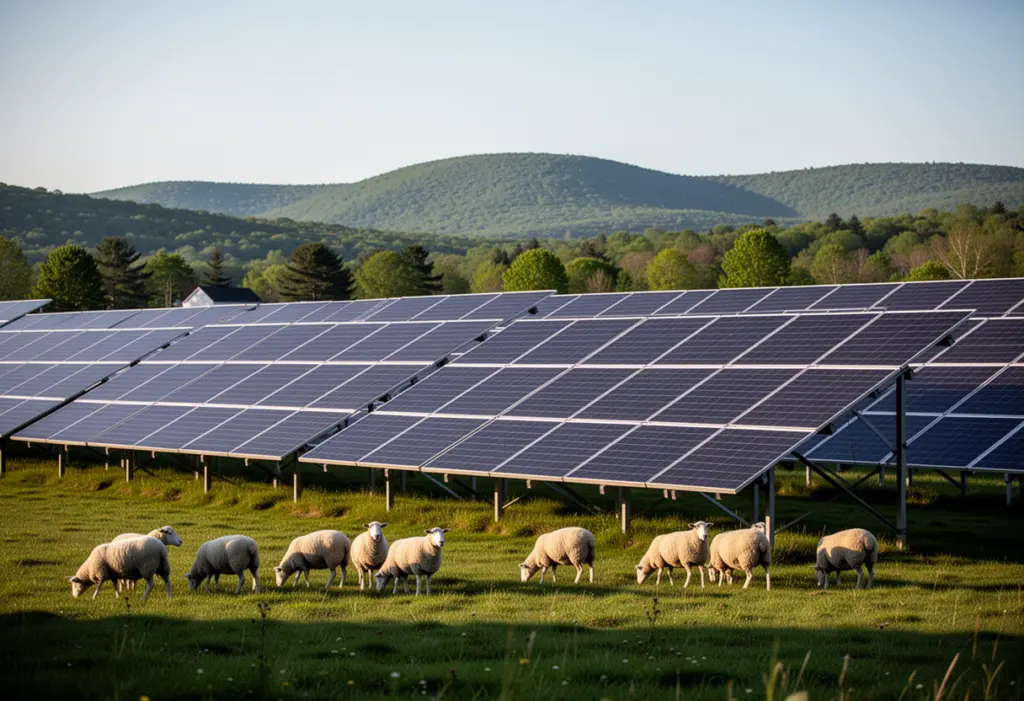
NYSEG’s scattered territory — the Southern Tier, parts of the Finger Lakes, pockets of the Hudson Valley and the North Country — contains a great many properties where rooftop solar genuinely will not work. Valley slopes, mature hardwoods, north-facing roofs, old roofs, rented houses. Community solar is the option that requires none of it.
How it works
You subscribe to a share of an off-site array. That array is connected to the grid on its own, in front of the meter, and the value of its generation is allocated among its subscribers by share. Your allocation arrives as a credit on your NYSEG account.
You pay the subscription provider for those credits at a discount to their face value. That discount is your saving. It is modest by design — this is a low-effort, no-capital arrangement, not a way to eliminate a bill — and any offer describing it otherwise is overselling.
Nothing is installed at your property. No roof work, no permit, no electrical inspection, no interconnection application, and no wait for permission to operate.
Why it fits NYSEG territory particularly well
- Shading is the deciding constraint here. A Southern Tier house on a valley slope with a hill to the south loses hours of winter production that no equipment choice recovers. Community solar is unaffected by your horizon.
- Rural circuits raise interconnection questions. A rooftop application can come back needing a study or a distribution upgrade. A subscription has no interconnection of its own to worry about.
- Rented and tenanted housing is common across the territory. There is nothing to install and nothing to leave behind.
- Old roofs. Rather than defer solar until the roof is replaced, subscribe now and revisit the roof later.
The structural advantage over a roof array
Community solar subscribers pay no Customer Benefit Contribution. That is the monthly charge every rooftop customer who interconnected on or after 1 January 2022 pays on their DC system size — $1.19 per kW-month on NYSEG for 2026, about $114 a year on an 8 kW system. It applies to behind-the-meter systems; community solar is front-of-the-meter and exempt.
What to check before subscribing
- Cancellation terms. Notice period, any fee, any minimum term. A good subscription is easy to leave, and this is the clause that most often is not.
- Moving. Within NYSEG territory a subscription can usually follow you. Moving into National Grid or RG&E territory is a different question and the answer belongs in the agreement.
- The discount, stated as two numbers — what you pay and what you receive — rather than a single percentage.
- Seasonality. Credits track the array’s actual production, so winter allocations are smaller than summer ones, exactly as they would be on your own roof.
- Billing. Separate invoice or consolidated. Know which before you start.
What it does not do
No backup power — there is no equipment at your property, so an outage affects you as before, which matters in a territory with long rural feeders and real storm exposure. No effect on property value. And no New York State tax credit: Form IT-255 is for equipment installed and used at your principal residence, which a subscription is not.
Income-eligible options
New York operates programmes aimed at making community solar reach lower-income households, and NYSERDA’s Affordable Solar work sits alongside them. If your household is below 80% of area median income, ask specifically what is available rather than waiting for it to be offered — in NYSEG’s rural counties this is worth doing.
The comparison that matters
Community solar is not competing with an owned rooftop array on a good roof. It is competing with doing nothing, which is the real alternative for most people in this territory who have looked at their roof and been told no. Against that, a modest saving requiring no capital and no equipment is a straightforwardly sensible arrangement.
Frequently Asked Questions
How does community solar work for a NYSEG customer?
You subscribe to a share of an off-site array; its generation is allocated among subscribers and arrives as a credit on your NYSEG account. You pay the provider for those credits at a discount to their face value, and the discount is your saving.
Is community solar better than rooftop solar in the Southern Tier?
For a property where shading, roof condition or tenancy rules out a roof array, yes — it is the only option that works. On a good unshaded roof with capital available, an owned system saves more over its life.
Do NYSEG community solar subscribers pay the CBC charge?
No. The Customer Benefit Contribution applies to behind-the-meter systems interconnected on or after 1 January 2022. Community solar is front-of-the-meter and exempt, which saves what a comparable rooftop system would pay — about $114 a year at NYSEG's 2026 rate on an 8 kW equivalent.
What should I check before signing a community solar agreement?
The cancellation terms above all — notice period, fee and minimum term. Then what happens if you move, the discount expressed as what you pay and what you receive, the seasonality of credits, and whether billing is separate or consolidated.
This article is general information, not tax, legal or financial advice. Incentive amounts, eligibility rules and deadlines change and depend on your utility, your tax situation and your property. Confirm current terms with NYSERDA, your utility and a qualified tax professional before making a decision.
NY Solar Incentives
Independent New York solar research. We summarise NYSERDA, NY-Sun and federal programme rules from published sources and state plainly when a figure is an estimate. We are not a government agency and do not sell equipment.
Run the arithmetic on your own system
Check the dated program table and your arrangement before counting an incentive. Standard residential NY-Sun blocks are closed; Long Island Affordable Solar has a conditional income-verification route. The NY credit depends on qualified costs and tax liability, while the NYC abatement reduces future property-tax bills. The estimator keeps those timings separate.