Solar Incentives in Dutchess County, NY
Dutchess combines Central Hudson's high CBC rate, heavy tree cover and a lot of historic property. Here is what each of those costs you.
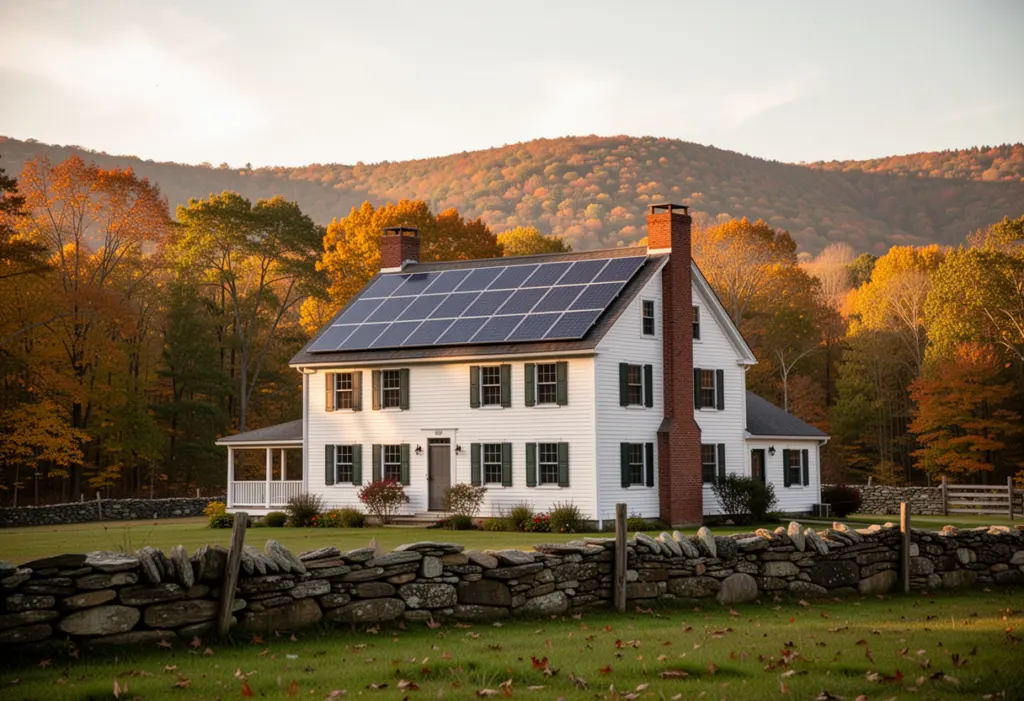
Dutchess County runs along the east bank of the Hudson from Beacon and Fishkill up through Poughkeepsie to Rhinebeck and Red Hook, taking in Hyde Park, Wappingers Falls, Pawling and Millbrook. ZIP codes here begin 125 and 126. Poughkeepsie is 12601.
Central Hudson carries the state’s highest solar charge
Most of Dutchess County is Central Hudson territory, and that is the single most important local number.
The Customer Benefit Contribution — a monthly charge on the DC size of your system, for anyone interconnecting on or after 1 January 2022 — is $1.67 per kW-month on Central Hudson for 2026. That is the highest residential rate in New York State.
- A 6 kW system: $10.02 a month, about $120 a year.
- An 8 kW system: $13.36 a month, about $160 a year.
- A 12 kW system: $20.04 a month, about $240 a year.
The same 8 kW system pays $7.76 a month in National Grid territory. Over twenty years the Central Hudson premium on that system is on the order of a thousand dollars — not decisive, but real, and it never appears in a sales proposal.
The charge is billed on capacity regardless of output and is recalculated annually rather than locked in at interconnection. Note that the county’s edges are not uniformly Central Hudson; confirm against the name on your own bill.
Trees and hillsides
Dutchess is wooded and hilly, and shading is frequently the deciding variable rather than one factor among several. The low winter sun angle means a ridge or a stand of mature hardwoods to the south removes hours of production in December that a July assessment would never reveal.
Insist on an on-site shading assessment and ask what the model assumes about winter. Where a roof genuinely will not work, a ground mount is realistic on many Dutchess properties — there is land here in a way there is not in Westchester — and community solar needs no roof at all.
Historic property is a real step
Rhinebeck, Hyde Park, Red Hook, Millbrook and parts of Poughkeepsie carry significant historic districts and local architectural review. That review is a municipal step that happens before the utility is involved, and it can restrict street-visible placement.
If your house sits in a district, raise it at the quoting stage. Discovering it after signing turns a schedule into a dispute.
Property tax — check all three levels
RPTL 487 exempts the added value of a solar system from property tax for 15 years unless the municipality has opted out. The RPTL 487 exemption is not automatic: file form RP-487 with your assessor by the taxable status date (March 1 in most towns; January 2 in Nassau towns; May 1 or June 1 in Westchester towns; set by charter in cities; usually January 1 in villages), and the system must be built before January 1, 2030 (RP-487 instructions). In Dutchess the town or village, the county and your school district each decide for their own levy, and any one of them may have opted out.
There is no county-wide answer. There is one answer per address, and it is worth establishing before you sign rather than discovering on a tax bill.
What is claimable in 2026
The federal 30% credit is gone. Section 25D was terminated for expenditures made after 31 December 2025, and an expenditure counts as made when the original installation is completed. A Dutchess system finished in December 2025 still qualifies even if Central Hudson granted permission to operate afterwards.
Still available: New York’s 25% credit capped at $5,000 on Form IT-255, non-refundable but carried forward five years and available on leases and PPAs of ten years or more as well as purchases; and the state sales tax exemption on residential solar equipment. Not available for now: NY-Sun, which was paid through your contractor, and its Affordable Solar incentive for households under 80% of area median income. As of September 2026 NYSERDA has no open NY-Sun block for homes in any utility territory; check NYSERDA’s NY-Sun dashboard for a new one.
What to establish before signing
- Your utility, from your own bill — Central Hudson for most of the county, but not all of it.
- The DC system size, and therefore your monthly CBC at $1.67 per kW.
- Whether historic or architectural review applies to your address.
- Your town’s, county’s and school district’s position on RPTL 487.
- Whether a ground mount is viable, if the roof is shaded.
- That no federal credit appears in the net-cost calculation.
Frequently Asked Questions
Why is the solar charge higher in Dutchess County?
Most of the county is Central Hudson territory, which carries the highest residential Customer Benefit Contribution rate in New York — $1.67 per kW-month for 2026, about $160 a year for an 8 kW system compared with $93 in National Grid territory.
Do Hudson Valley historic districts affect solar permits?
Yes. Rhinebeck, Hyde Park, Red Hook, Millbrook and parts of Poughkeepsie have historic districts with local architectural review, which happens before the utility is involved and can restrict street-visible placement.
Is my Dutchess County property exempt from solar property tax?
RPTL 487 exempts the added value for 15 years where the municipality has not opted out, but the town or village, the county and the school district each decide for their own levy. There is one answer per address, not a county-wide one.
What if my Dutchess County roof is too shaded?
A ground mount is realistic on many Dutchess properties because there is land available, and it allows optimal orientation. Community solar is the alternative that needs no roof at all and whose subscribers are exempt from the Customer Benefit Contribution.
This article is general information, not tax, legal or financial advice. Incentive amounts, eligibility rules and deadlines change and depend on your utility, your tax situation and your property. Confirm current terms with NYSERDA, your utility and a qualified tax professional before making a decision.
NY Solar Incentives
Independent New York solar research. We summarise NYSERDA, NY-Sun and federal programme rules from published sources and state plainly when a figure is an estimate. We are not a government agency and do not sell equipment.
Run the arithmetic on your own system
Check the dated program table and your arrangement before counting an incentive. Standard residential NY-Sun blocks are closed; Long Island Affordable Solar has a conditional income-verification route. The NY credit depends on qualified costs and tax liability, while the NYC abatement reduces future property-tax bills. The estimator keeps those timings separate.