Solar Incentives in Albany County, NY
Albany County splits sharply between a historic city and straightforward suburbs. The incentives are the same; the installation is not.
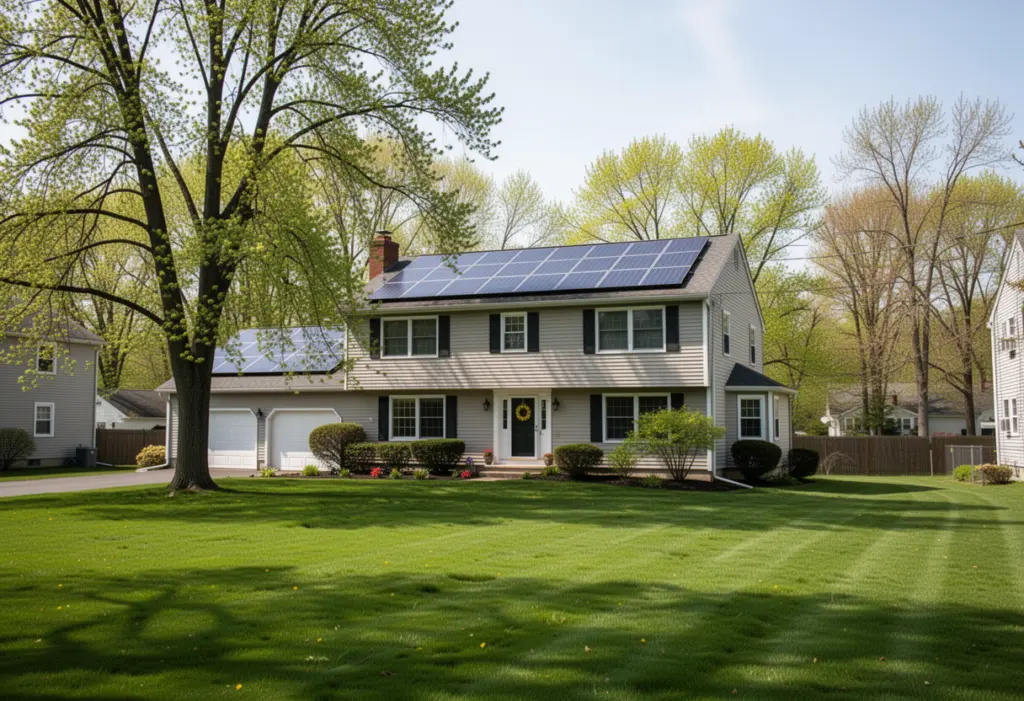
Albany County covers the state capital and the towns around it — Colonie, Guilderland, Bethlehem, Delmar, Cohoes, Watervliet, Voorheesville. ZIP codes here begin 120 and 122. What is distinctive about solar here is not the weather but the split between a dense nineteenth-century city and conventional post-war suburbs a few miles away.
Two very different installations
In the City of Albany, much of the housing is attached brick row housing with flat or shallow-pitch roofs, a great deal of it inside historic districts — Center Square, Washington Park, Ten Broeck Triangle, Mansion. That means ballasted or tilted mounting rather than flush racking, no natural snow shedding, harder staging on an attached house, and a historic review step that happens before the municipal permit and long before the utility.
In Colonie, Guilderland, Bethlehem and Delmar, it is a conventional pitched-roof suburban installation and none of that applies.
If you are in the city, raise the historic district question at the quoting stage rather than after signing.
National Grid: the lowest solar charge of the major New York utilities
Albany County is National Grid territory. Its 2026 residential Customer Benefit Contribution — the monthly charge on DC system size for anyone interconnecting on or after 1 January 2022 — is $0.97 per kW-month, the lowest of the major New York utilities.
An 8 kW system pays $7.76 a month, about $93 a year. The same system in Central Hudson territory, an hour south, pays $13.36. The charge is billed on capacity regardless of output and is recalculated annually rather than fixed at interconnection.
Weather, honestly
Capital District production is solidly middling for New York — better than Rochester’s grey winters, less than Long Island. Snow load is moderate by upstate standards: heavier than downstate, lighter than the Buffalo lake-effect belt or the Tug Hill. Racking still has to be specified for it, and snow guards matter where an array sits above a door or a driveway.
Panels shed snow faster than the roof around them, and the days lost fall in the weakest production months, so the annual figure absorbs it — provided the production estimate included a snow assumption in the first place. Ask what it was.
What is claimable in 2026
The federal 30% credit is gone. Section 25D was terminated for expenditures made after 31 December 2025, with an expenditure treated as made when the original installation is completed — not when the system is placed in service. A December 2025 completion qualifies even where permission to operate came in 2026.
Still available:
- New York’s 25% credit, capped at $5,000, on Form IT-255. Non-refundable, carried forward five years, and available on leases and PPAs of ten years or more as well as purchases.
- The state sales tax exemption on residential solar equipment.
- RPTL 487, the 15-year property tax exemption on the added value, where the municipality has not opted out. The RPTL 487 exemption is not automatic: file form RP-487 with your assessor by the taxable status date (March 1 in most towns; January 2 in Nassau towns; May 1 or June 1 in Westchester towns; set by charter in cities; usually January 1 in villages), and the system must be built before January 1, 2030 (RP-487 instructions). The city or town, the county and your school district each decide for their own levy in Albany County.
Not available for now: NY-Sun, which was paid through the contractor as a price reduction, and its Affordable Solar incentive for households below 80% of area median income. In NYSERDA’s Upstate region the last standard residential block, open only in NYSEG, RG&E and National Grid territory, closed on 17 December 2025, and the Upstate Affordable Solar block closed on 9 March 2026. As of September 2026 NYSERDA has no open NY-Sun block for homes in any utility territory; check NYSERDA’s NY-Sun dashboard for a new one.
Roof first
Capital District housing runs old, particularly in the city and the older river towns. If the shingles have under roughly ten years of life left, replace the roof before installing — removing and reinstalling an array later to re-roof costs considerably more than mounting on a bare roof. Get that assessed by someone who is not selling you panels.
The permit step
The City of Albany, Colonie, Guilderland, Bethlehem, Cohoes and Watervliet each run their own building departments with their own turnarounds. The utility step is identical everywhere. Ask your installer what your specific authority is currently running at, based on their own recent work there.
Frequently Asked Questions
Which utility serves Albany County for solar?
National Grid, which handles the interconnection application and grants permission to operate. Its 2026 residential Customer Benefit Contribution rate is $0.97 per kW-month, the lowest of the major New York utilities — about $93 a year for an 8 kW system.
Can you install solar on a historic Albany row house?
Often yes, but historic district review applies in areas such as Center Square, Washington Park and Mansion, and can restrict street-visible placement. Flat and shallow-pitch roofs also need ballasted or tilted mounting rather than flush racking.
What can an Albany County homeowner claim in 2026?
New York's 25% credit capped at $5,000 on Form IT-255, the state sales tax exemption, and RPTL 487's property tax exemption where the municipality has not opted out. NY-Sun, including NYSERDA's Affordable Solar incentive for lower-income households, has no open block for homes as of September 2026.
Is Capital District snow a problem for solar?
Moderate by upstate standards — heavier than downstate, lighter than the Buffalo lake-effect belt. Racking must be specified for the local load and snow guards matter above doors and driveways, but panels shed snow faster than the roof around them.
This article is general information, not tax, legal or financial advice. Incentive amounts, eligibility rules and deadlines change and depend on your utility, your tax situation and your property. Confirm current terms with NYSERDA, your utility and a qualified tax professional before making a decision.
NY Solar Incentives
Independent New York solar research. We summarise NYSERDA, NY-Sun and federal programme rules from published sources and state plainly when a figure is an estimate. We are not a government agency and do not sell equipment.
Run the arithmetic on your own system
Check the dated program table and your arrangement before counting an incentive. Standard residential NY-Sun blocks are closed; Long Island Affordable Solar has a conditional income-verification route. The NY credit depends on qualified costs and tax liability, while the NYC abatement reduces future property-tax bills. The estimator keeps those timings separate.