The Con Edison Heat Pump Rebate, Line by Line
Con Edison's heat pump rebate is its share of NYS Clean Heat, paid off your contractor's invoice. Here is the structure, the categories, and where the live amount lives.
On this page 6 sections
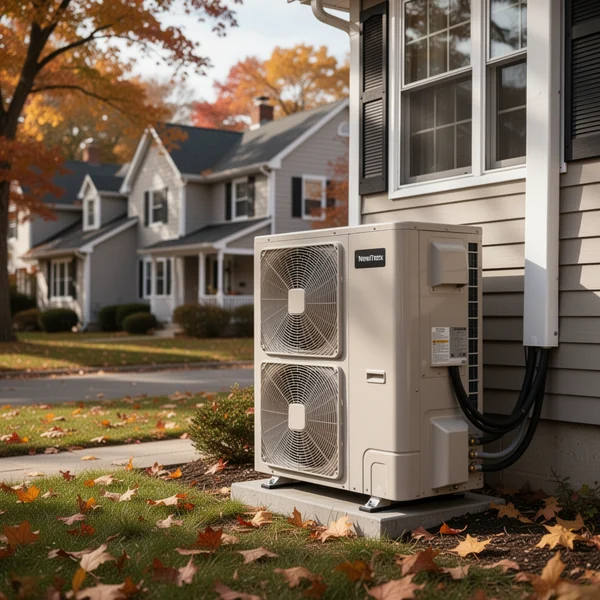
The Con Edison heat pump rebate is Con Edison’s share of NYS Clean Heat, the statewide programme NYSERDA administers with seven sponsoring utilities. It does not arrive as a cheque — it comes off your contractor’s invoice before you pay, which means the contractor has to be enrolled in the programme and the money never passes through your hands.
That mechanism, rather than any particular dollar figure, is the thing worth understanding, because the figures are revised and are not published as a single statewide table. What does not change is the structure: who is eligible, which equipment categories the tiers follow, what the contractor has to file, and what happens on the Con Edison side of your electrical service.
How the Con Edison heat pump rebate is actually structured
Con Edison is one of the seven NYS Clean Heat sponsors, alongside Central Hudson, National Fuel Gas, National Grid, NYSEG, Orange & Rockland and RG&E. Each sponsor funds and administers its own incentive levels within the programme’s shared framework, which is why “the New York heat pump rebate” is not one number — a Bronx address and a Rochester address are drawing on different utility budgets under the same programme name.
It is off-invoice, through a participating contractor
You do not apply. Your contractor applies on your behalf, against your Con Edison account, and shows the incentive as a line item reducing the contract price. Three practical consequences follow:
- A contractor who is not enrolled cannot get you the money. Not later, not retroactively, not by you filing something afterwards. Confirm enrolment before you sign.
- The rebate is tied to the Con Edison account at the service address, so the account holder details on the paperwork have to be right. Mismatches between the name on the contract and the name on the utility account are the most common cause of a stalled submission.
- Incentive levels can change between signing and installing. Ask, in writing, who absorbs the difference if the programme level moves. This is a contract term, not a courtesy.
The equipment categories the tiers follow
Clean Heat incentives are set per category rather than per project, and the categories are broadly consistent across sponsors even though the amounts are not. The distinctions that determine which bucket your job lands in:
- Air source, ducted or ductless. A ducted air handler serving the whole house and a set of ductless wall heads are treated as different installations.
- Whole-home versus partial-load. A system sized and controlled to carry the entire heating load — with the existing fossil-fuel system decommissioned — is a different category from one that shares the season with a retained boiler or furnace. This distinction is usually the largest single driver of the incentive level, so if you are considering keeping the boiler as backup, ask what that decision does to the rebate before you make it.
- Ground source. Geothermal has its own tier and its own contractor pool, because the loop field is a drilling trade rather than an HVAC one.
- Heat pump water heaters. A separate category again, and one worth pricing at the same time since the site visit overlaps.
There are also income-qualified pathways that increase what a household can receive. Those run through NYSERDA’s programmes rather than through the utility’s standard tier, and the current thresholds are not something to take from a third-party page — call 1-866-NYSERDA and get the position for your household.
Why this page does not print a dollar amount
Because there is no honest way to. Clean Heat rebate amounts are set per sponsoring utility and per equipment type, they are revised, and NYSERDA does not publish them as one statewide table. Every page you find quoting a per-ton figure for Con Edison is either copying an old programme document or making it up, and a quote built on a stale number is a quote that comes up short at the end.
The authoritative route is the address-based finder: cleanheat.ny.gov/find-available-rebates. Enter your service address, and it returns what applies to you, for your utility, for the equipment categories available. Do this yourself before you take quotes. Arriving at a sales conversation already knowing the incentive layer is the single cheapest piece of preparation available to you.
Who is inside Con Edison territory, and who is not
Con Edison delivers electricity to the five boroughs of New York City and to most of Westchester County. If that is your address, the Con Edison heat pump rebate is your route.
Two boundaries catch people. Orange & Rockland is a separate Clean Heat sponsor with its own incentive levels — Rockland County and parts of Orange and Sullivan sit there, not with Con Edison, despite the corporate relationship. And PSEG Long Island is not a NYS Clean Heat sponsoring utility at all. Nassau and Suffolk households are outside this programme entirely and should be looking at PSEG Long Island’s own efficiency and heat pump offers, which have different rules, different paperwork and a different eligible equipment list. Searching Clean Heat pages for a Long Island rebate produces confusion rather than money.
Parts of Westchester and the Bronx also sit in the odd position of having Con Edison for electricity and a different supplier arrangement for gas. The rebate follows the electric account for an electrification measure, but confirm it rather than assuming.
The federal credit that used to stack, and does not any more
Clean Heat rebates were designed to be combined with federal incentives, and for several years a New York household could take the utility rebate and then claim a federal credit on the reduced cost. That is over.
Section 25C, the Energy Efficient Home Improvement Credit, allowed a credit for qualifying property placed in service through 31 December 2025, with annual caps of $1,200 for the general bucket and $2,000 for heat pumps, heat pump water heaters and biomass equipment. Section 25D, the Residential Clean Energy Credit, terminated for expenditures after the same date. A New York household installing in 2026 gets nothing federal.
This matters more than it sounds, because the federal layer was the largest single number in most 2024 and 2025 quotes. If a salesperson is still showing you a 30 per cent federal credit or a $2,000 heat pump credit for a 2026 install, that quote is wrong, and the payback period built on top of it is wrong by a wide margin. The same shift ran through the solar side of the state’s incentive picture — the background is in the federal solar tax credit and New York: what changed.
The Con Edison side of the job that is not the rebate
A whole-home heat pump is a substantial new electrical load, and in Con Edison territory that raises two questions the rebate paperwork does not answer.
The first is your panel. Many NYC row houses, Bronx two-families and pre-war Westchester houses still run 100-amp service, and a load calculation may show that a ducted heat pump plus an existing electric range plus anything else you are planning does not fit. A service upgrade is a Con Edison job as well as an electrician’s job, and it has its own lead time. Ask any contractor whether a panel or service upgrade is inside or outside their quoted price, and get the answer in writing.
The second is your bill. Electrifying heat moves cost from an oil or gas bill onto the electric bill, and the electric bill in Con Edison territory has a structure worth understanding before you are surprised by it — supply and delivery are separate halves with different drivers. The walk-through in reading a Con Edison bill after solar covers how those components sit on the page, and the same anatomy applies whether the change on your roof is panels or the change in your basement is a heat pump. If you already have or are planning solar, Con Edison net metering explains how the credits interact with a larger winter load.
What to do next
- Run your service address through the Clean Heat rebate finder before you speak to any contractor, and write down what it returns.
- Confirm each contractor’s Clean Heat enrolment and ask which equipment category they intend to file your job under.
- Decide the whole-home versus partial-load question deliberately, knowing what it does to both the incentive and the winter bill.
- Get the panel question settled in writing — inside the price or outside it — before you sign.
- Call 1-866-NYSERDA to check whether your household qualifies for an income-based pathway.
- Delete any federal tax credit line from a 2026 quote and recalculate the total yourself.
NY Solar Incentives
Independent New York solar research. We summarise NYSERDA, NY-Sun and federal programme rules from published sources and state plainly when a figure is an estimate. We are not a government agency and do not sell equipment.
Run the arithmetic on your own system
Check the dated program table and your arrangement before counting an incentive. Standard residential NY-Sun blocks are closed; Long Island Affordable Solar has a conditional income-verification route. The NY credit depends on qualified costs and tax liability, while the NYC abatement reduces future property-tax bills. The estimator keeps those timings separate.