What Solar Panels Cost in Auburn, NY in 2026
In Auburn the first cost question is not how many panels. It is which utility name is printed on your bill, because two neighbouring territories charge different monthly rates for the same array.
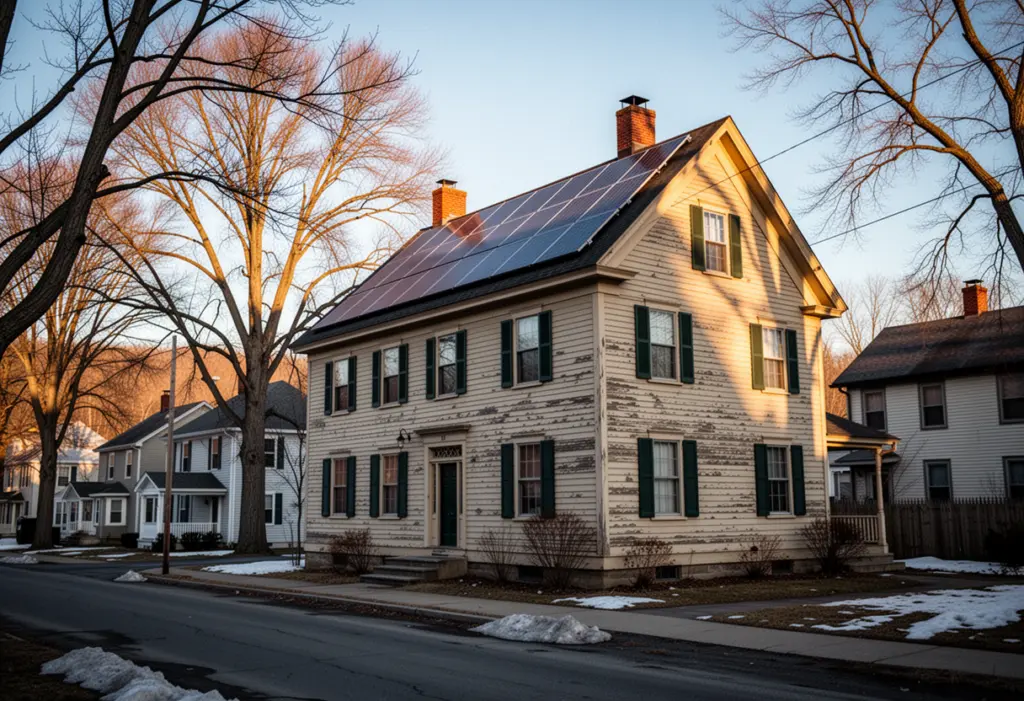
The first cost question in Auburn is not how many panels the roof will hold. It is which utility is printed on your electricity bill, because Cayuga County sits where two service territories meet and the monthly charge attached to a solar array is not the same in both. That single fact can be worth more than a negotiation over hardware, and it takes thirty seconds to check.
Read the name on your own bill first
Service territories in New York do not follow county lines, and this part of the state is exactly where that bites: National Grid serves much of central New York while NYSEG covers a good deal of the Finger Lakes, and the boundary between them is not a map you can guess from. So look at the bill.
It matters because the Customer Benefit Contribution, a monthly charge on the DC size of your system rather than on what it produces, is set per utility. For 2026 the residential rates are $1.19 per kW-month on NYSEG and $0.97 on National Grid. On a 10 kW array that is $11.90 a month, about $143 a year against $9.70 a month, about $116 a year — roughly $26 a year decided by nothing you control. The charge applies to systems interconnected on or after 1 January 2022, and the rates are recalculated annually rather than fixed at interconnection, so use this year’s figure as this year’s figure.
And if your utility is neither
A short distance east, the Village of Skaneateles runs its own municipal electric department, and it is not alone in this part of the state. A municipal electric customer is outside Public Service Commission jurisdiction entirely: no state net metering rules, no Customer Benefit Contribution, and no state interconnection process. The terms are whatever the municipal utility sets, and they have to be asked for directly rather than assumed from any statewide guide, including this one. This is another reason to start with the bill rather than with the ZIP code.
The city issues the permit
Auburn is a city, the seat of Cayuga County, covering the 13021 ZIP code, so the permit comes from the city rather than from a town hall. Ask which office handles solar applications and what the review timeline looks like. New York’s Unified Solar Permit standardises residential applications for systems of 25 kW DC and under and has been adopted by more than 300 authorities having jurisdiction across the state; asking whether your application uses it is a reasonable question, not a difficult one.
What the housing stock does to a quote
A city with a great deal of pre-war housing produces cost drivers that a suburban quote sheet does not anticipate.
- Roof material. Slate and steep pitches need specialist hooks, flashing and labour. If the proposal was priced against asphalt shingle, it will not hold.
- Roof framing. Original framing on an old house may need a structural review before an array is added. Ask whether it is included and who signs it.
- Chimneys and dormers. They break a roof into small planes, which raises racking and labour per kilowatt and often means module level electronics.
- Electrical service. Older services and older wiring may need upgrading before a solar breaker can be added. Establish the rating and the free breaker positions at the survey.
Winter, and what to ignore
Central New York gets serious snow, and it will affect production in the months you use the most electricity. What it does not usually justify is buying anything to manage it. Snow slides off a pitched array as it warms, and paying for clearing or heating on the strength of a sales pitch rarely pays for itself. What is worth doing is interrogating the estimate: ask what the model assumes for December, January and February specifically, and whether the shading assessment was taken on site or from aerial imagery. Full retail rate net metering under Phase One holds for 20 years from interconnection and lets a strong summer carry a weak winter, which is the mechanism that makes solar work at this latitude — but it is not a reason to oversize. Credits you never draw down still cost you panels and still cost you the monthly capacity charge.
Incentives, and the three property tax checks
There is no federal credit for a buyer. Section 25D was terminated for expenditures made after 31 December 2025, and an expenditure is treated as made when the original installation is completed, so any 2026 quote for an Auburn house showing 30 percent federal is materially wrong. New York’s own credit remains: 25 percent of qualified expenditure capped at $5,000 on Form IT-255, for your principal residence, not refundable but carried forward up to five years and limited by the state tax you actually owe.
NY-Sun, a contractor-applied reduction paid in regional megawatt blocks, is not available to a house right now, so do not accept a figure for it from a sales deck. As of September 2026 NYSERDA has no open NY-Sun block for homes in any utility territory; check NYSERDA’s NY-Sun dashboard for a new one. The Affordable Solar incentive for households under 80 percent of area median income, also applied by the contractor, is closed too: its Upstate track ran from 18 December 2025 to 9 March 2026. Residential solar equipment is exempt from state sales tax, with localities separately electing on their own share. Under RPTL 487 the added value is exempt from property tax for 15 years, but only where the City of Auburn, Cayuga County and the city school district have each not opted out — three separate questions for the assessor — and the system must be constructed before 1 January 2030. Confirm the current position with NYSERDA and New York State Taxation and Finance before you sign anything.
Frequently Asked Questions
Which utility serves Auburn NY?
Check the name printed on your own bill. Cayuga County sits where National Grid's central New York territory meets NYSEG's Finger Lakes coverage, and service boundaries do not follow county lines, so guessing from the address is unreliable.
How much is the monthly capacity charge here?
It depends on the utility. For 2026 the residential Customer Benefit Contribution is $1.19 per kW-month on NYSEG and $0.97 on National Grid, so a 10 kW array pays about $11.90 a month against $9.70 — roughly $143 or $116 a year.
What if I am on a municipal electric utility?
Then most statewide guidance does not apply to you. Municipal utilities such as the Village of Skaneateles electric department sit outside Public Service Commission jurisdiction, so there is no state net metering rule, no capacity charge and no state interconnection process. Ask the utility directly.
Is snow clearing worth paying for in central New York?
Rarely. Snow slides off a pitched array as it warms, and clearing or heating services seldom repay their cost. It is more useful to ask what the production model assumes for December, January and February and whether shading was assessed on site.
This article is general information, not tax, legal or financial advice. Incentive amounts, eligibility rules and deadlines change and depend on your utility, your tax situation and your property. Confirm current terms with NYSERDA, your utility and a qualified tax professional before making a decision.
NY Solar Incentives
Independent New York solar research. We summarise NYSERDA, NY-Sun and federal programme rules from published sources and state plainly when a figure is an estimate. We are not a government agency and do not sell equipment.
Run the arithmetic on your own system
Check the dated program table and your arrangement before counting an incentive. Standard residential NY-Sun blocks are closed; Long Island Affordable Solar has a conditional income-verification route. The NY credit depends on qualified costs and tax liability, while the NYC abatement reduces future property-tax bills. The estimator keeps those timings separate.