Solar Panel Installation in Port Jefferson, NY
Port Jefferson sits in a bowl of wooded hillsides around its harbour, and that topography decides more about a solar design here than the equipment does.
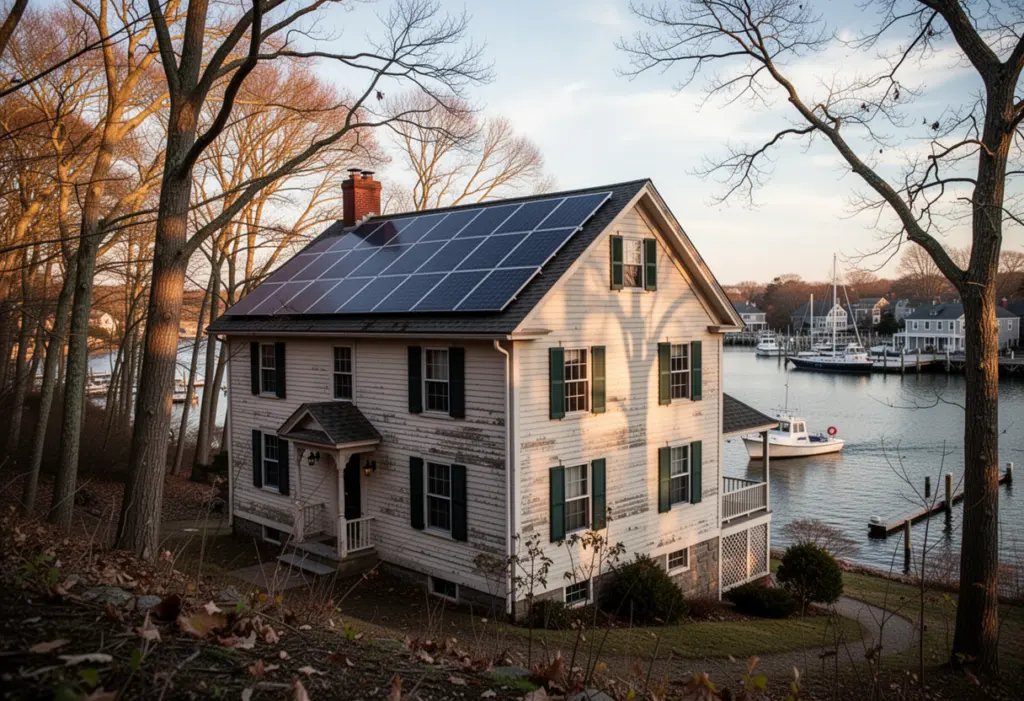
Port Jefferson is harder to design solar for than most of Suffolk County, and the reason is geography rather than regulation. The village sits in a bowl of wooded hillsides around the harbour, so a house that looks perfectly suitable on a satellite image can lose its winter production entirely to a ridge and a stand of mature trees. Getting that assessed properly is the first job, before anyone quotes a system size.
Village or Station: two different permits
The first practical question is which authority covers your address. The incorporated Village of Port Jefferson, in the 11777 ZIP code, runs its own building department. Port Jefferson Station, the unincorporated area to the south in 11776, is part of the Town of Brookhaven and applies there. They are adjacent, they share a name, and they are separate jurisdictions with separate processes. Confirm which one your parcel falls in at the site survey, and have it written into the contract. New York’s Unified Solar Permit standardises residential applications for systems of 25 kW DC and under and has been adopted by more than 300 authorities having jurisdiction across the state, so ask which application form is being filed.
Shading in a bowl, and why December matters
The sun sits lowest in the sky in the months you consume the most, which is exactly when a hillside or a tall oak to the south does the most damage. A generic annual production figure hides that completely. Ask for three specific things:
- An on-site shading assessment taken from the roof, not a desktop estimate from aerial imagery.
- Production estimated month by month, with December and January called out.
- What the model assumes about tree growth, since the canopy that clears your roof today may not in eight years, and what the design does about it.
If the honest answer is that the site supports a smaller array than you hoped, that is useful information and it is cheaper to receive it now. It is also a reason to look seriously at a community solar subscription instead, which carries no capacity charge and does not depend on your roof at all.
Old roofs, steep pitches and review boards
Much of the village housing stock is genuinely old, with steep pitches and, in places, slate. Slate is not a surface a general solar crew should improvise on: it needs specialist hooks and flashing details, and a quote priced against asphalt shingle assumptions will not survive the first day. Steep pitches also change the labour, the safety setup and the staging.
Where a property falls within historic review, expect questions about visibility from the street. The usual resolutions are moving modules to rear or side planes, all-black hardware, and careful conduit routing, and each of those has a cost or a production consequence. Raise it at the survey rather than discovering it when the application comes back.
Interconnection, inspection and switch-on
The utility side is the same either side of the village line. The interconnection application goes to PSEG Long Island, which operates the LIPA system serving the area — confirm the utility name printed on your own bill, since Long Island does contain municipal exceptions that sit outside these rules altogether. The electrical inspection is normally carried out by an approved inspection agency, and the certificate feeds the utility’s final sign-off. The array stays switched off until permission to operate arrives. Ask for a written sequence with a named owner for each step.
The monthly charge on capacity
The Customer Benefit Contribution is billed on the DC size of the system rather than on production, and applies to systems interconnected on or after 1 January 2022. At the 2026 residential rate of $1.13 per kW-month for LIPA and PSEG Long Island, an 8.5 kW array pays about $9.61 a month, roughly $115 a year. Rates are recalculated annually rather than locked at interconnection. On a shaded site this deserves particular attention: capacity that trees prevent from producing is still capacity you are billed for every month, which is another argument for sizing to what the roof can genuinely deliver.
What is actually available in 2026
The federal residential credit is not. Section 25D ended for expenditures made after 31 December 2025, with an expenditure treated as made when the original installation is completed, so a 2026 buyer claims nothing federally and any proposal showing 30 percent is wrong. New York’s own credit — 25 percent of qualified expenditure, capped at $5,000, on Form IT-255 for your principal residence — remains, along with the state sales tax exemption and RPTL 487’s 15-year exemption on added property value where the village or town, Suffolk County and the school district have each not opted out. NY-Sun, which the contractor applies as a price reduction when a block is open, and its Affordable Solar incentive are not on that list: as of September 2026 NYSERDA has no open NY-Sun block for homes in any utility territory; check NYSERDA’s NY-Sun dashboard for a new one. Check the current position with NYSERDA and New York State Taxation and Finance before signing; these programmes are revised, and a sales sheet is not a source.
Frequently Asked Questions
Is Port Jefferson Station the same jurisdiction as the village?
No. The incorporated Village of Port Jefferson in 11777 runs its own building department, while Port Jefferson Station in 11776 is unincorporated and permits through the Town of Brookhaven. Confirm which covers your parcel before an application is filed.
How do I know if my site is too shaded?
Ask for an on-site shading assessment taken from the roof rather than a desktop estimate, and for production month by month with December and January called out. Winter is when the sun is lowest and a hillside or tall trees to the south cost the most.
Can solar be installed on a slate roof?
Yes, but it needs specialist hooks and flashing and a crew that has done it. A quote priced on asphalt shingle assumptions will not hold once work starts, so confirm the roof surface is correctly identified in the proposal.
Does shading affect the monthly capacity charge?
Not at all, and that is the point. The Customer Benefit Contribution is billed on DC system size, so at $1.13 per kW-month an 8.5 kW array pays about $9.61 a month whether or not trees stop it producing. Size to what the roof can genuinely deliver.
This article is general information, not tax, legal or financial advice. Incentive amounts, eligibility rules and deadlines change and depend on your utility, your tax situation and your property. Confirm current terms with NYSERDA, your utility and a qualified tax professional before making a decision.
NY Solar Incentives
Independent New York solar research. We summarise NYSERDA, NY-Sun and federal programme rules from published sources and state plainly when a figure is an estimate. We are not a government agency and do not sell equipment.
Run the arithmetic on your own system
Check the dated program table and your arrangement before counting an incentive. Standard residential NY-Sun blocks are closed; Long Island Affordable Solar has a conditional income-verification route. The NY credit depends on qualified costs and tax liability, while the NYC abatement reduces future property-tax bills. The estimator keeps those timings separate.