What Solar Panels Cost in Valley Stream, NY in 2026
Two Valley Stream houses on the same block can get quotes thousands apart, and the reason is usually the roof geometry rather than the equipment on it.
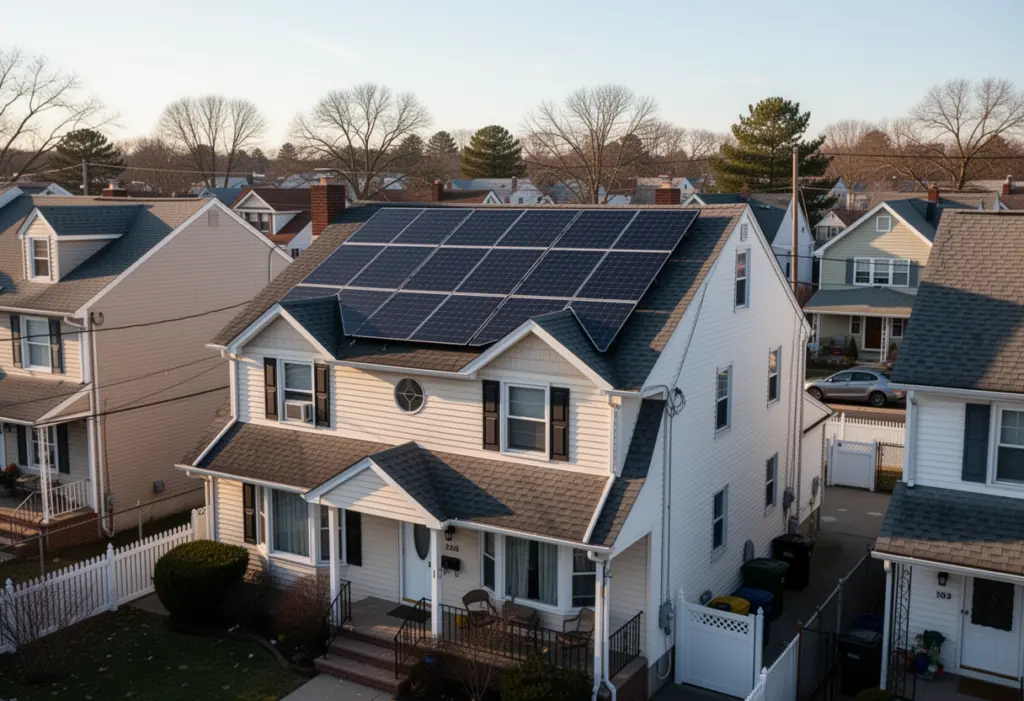
Two houses on the same Valley Stream block can receive solar quotes thousands of dollars apart for the same output, and the cause is almost never the panel brand. It is roof geometry, electrical service and how much of the array has to be split across planes that face different directions. Understanding that before the sales visit is what lets you compare proposals instead of comparing sales pitches.
The village housing stock is the cost driver
Much of Valley Stream, across the 11580, 11581 and 11582 ZIP codes, is compact interwar and post-war housing on small lots: capes and colonials, many with attics that were dormered decades after the house was built. That produces roof surfaces that are small, interrupted and multi-directional. The practical effects on a quote are consistent:
- More racking per kilowatt. Three small planes cost more to mount than one large one, and the labour does not scale down with the panel count.
- Module level electronics. Mixed orientations and partial shading from neighbouring houses and street trees usually mean optimisers or microinverters, which is a legitimate cost rather than an upsell.
- Framing changes. Where a dormer or addition altered the original structure, ask whether a structural review is included and who signs it.
- Access and staging. Narrow driveways and tight side yards affect how the crew stages material and sets up safely, and that shows up in labour.
Ask each installer for the number of roof planes in the design and the panel count on each one. Two quotes that both say 6 kW can be completely different jobs, and the cheaper one is sometimes cheaper because it quietly dropped the least productive plane.
What your service panel can take
Older Nassau County housing frequently still runs a 100 amp service, and some has been extended over the years by whoever was available at the time. A solar breaker has to land somewhere, and if an EV charger or a heat pump is anywhere in your plans, the panel is the constraint you will hit before the roof is. Establish the service size and the available breaker space early. A service upgrade discovered halfway through is a change order; a service upgrade priced at the start is a decision.
The capacity charge, in this year’s numbers
Valley Stream is served by the LIPA system operated by PSEG Long Island, and you should confirm that from the name on your bill. The Customer Benefit Contribution is charged monthly on the DC size of the system rather than on what it generates, and it applies to systems interconnected on or after 1 January 2022. At the 2026 residential rate of $1.13 per kW-month, a 6 kW array pays $6.78 a month, about $81 a year. It is not a large number, but it is a real one that most proposals omit, and because the rates are recalculated annually it is not fixed for the life of the system.
Worth knowing for context: not every Nassau community is on that utility. Freeport and Rockville Centre run their own municipal electric utilities, and municipal customers are outside Public Service Commission jurisdiction altogether — no state net metering rules, no capacity charge, no state interconnection process. If a relative a few miles away tells you their solar arrangement works differently, that may be exactly why.
The state credit on a modest system
New York’s credit is 25 percent of qualified expenditure with a $5,000 ceiling, claimed on Form IT-255 for your principal residence. On a system of this size the ceiling usually does not bite, so the practical limit is different: the credit is not refundable. It can only reduce New York State tax you actually owe, though unused credit carries forward for up to five years. If your state liability is small, the credit is worth less to you this year than the headline suggests, and that belongs in the payback conversation. The federal 30 percent credit is not an option at all — section 25D ended for expenditures made after 31 December 2025, with the expenditure treated as made when the original installation is completed.
Property tax, and the three checks that decide it
RPTL 487 exempts the added value of a solar system from property tax for 15 years, but only where the municipality, the county and the school district have each not opted out. In Valley Stream the school question is worth asking precisely, because the community is served by more than one school district and the levies on your parcel are not the same for every address in the village. Ask the assessor to confirm all three for your parcel specifically, and note that the exemption requires construction before 1 January 2030. Beyond that, residential solar equipment is exempt from state sales tax. NY-Sun’s contractor-applied price reduction and its Affordable Solar incentive for households under 80 percent of area median income are not available at present: PSEG Long Island’s last residential NY-Sun block closed on 17 April 2016, and as of September 2026 NYSERDA has no open NY-Sun block for homes in any utility territory; check NYSERDA’s NY-Sun dashboard for a new one. All of these change over time, so confirm the current position with NYSERDA and with New York State Taxation and Finance rather than trusting a printed sales sheet.
Frequently Asked Questions
Why do Valley Stream solar quotes vary so much?
Usually roof geometry rather than equipment. Small dormered capes give short, multi-directional roof planes, which means more racking per kilowatt, module level electronics for mixed orientation, and sometimes a structural review where a dormer changed the framing.
What does the monthly capacity charge cost here?
At the 2026 residential rate of $1.13 per kW-month for LIPA and PSEG Long Island, a 6 kW array pays $6.78 a month, about $81 a year. It is billed on DC system size rather than production and applies to systems interconnected on or after 1 January 2022.
Will I get the full $5,000 New York credit?
Only if you spend enough to reach it and owe enough state tax to use it. The credit is 25% of qualified expenditure capped at $5,000, it is not refundable, and it can only offset New York State tax you actually owe, with unused amounts carried forward up to five years.
Does the property tax exemption apply automatically?
No. RPTL 487 exempts the added value for 15 years only where the municipality, the county and the school district have each not opted out. Ask the assessor to confirm all three for your parcel, and note the system must be constructed before 1 January 2030.
This article is general information, not tax, legal or financial advice. Incentive amounts, eligibility rules and deadlines change and depend on your utility, your tax situation and your property. Confirm current terms with NYSERDA, your utility and a qualified tax professional before making a decision.
NY Solar Incentives
Independent New York solar research. We summarise NYSERDA, NY-Sun and federal programme rules from published sources and state plainly when a figure is an estimate. We are not a government agency and do not sell equipment.
Run the arithmetic on your own system
Check the dated program table and your arrangement before counting an incentive. Standard residential NY-Sun blocks are closed; Long Island Affordable Solar has a conditional income-verification route. The NY credit depends on qualified costs and tax liability, while the NYC abatement reduces future property-tax bills. The estimator keeps those timings separate.