Solar Tax Credit Documents to Keep, and For How Long
The invoice you file away this spring may still be supporting a return five years from now. That is what makes solar paperwork different from ordinary receipts.
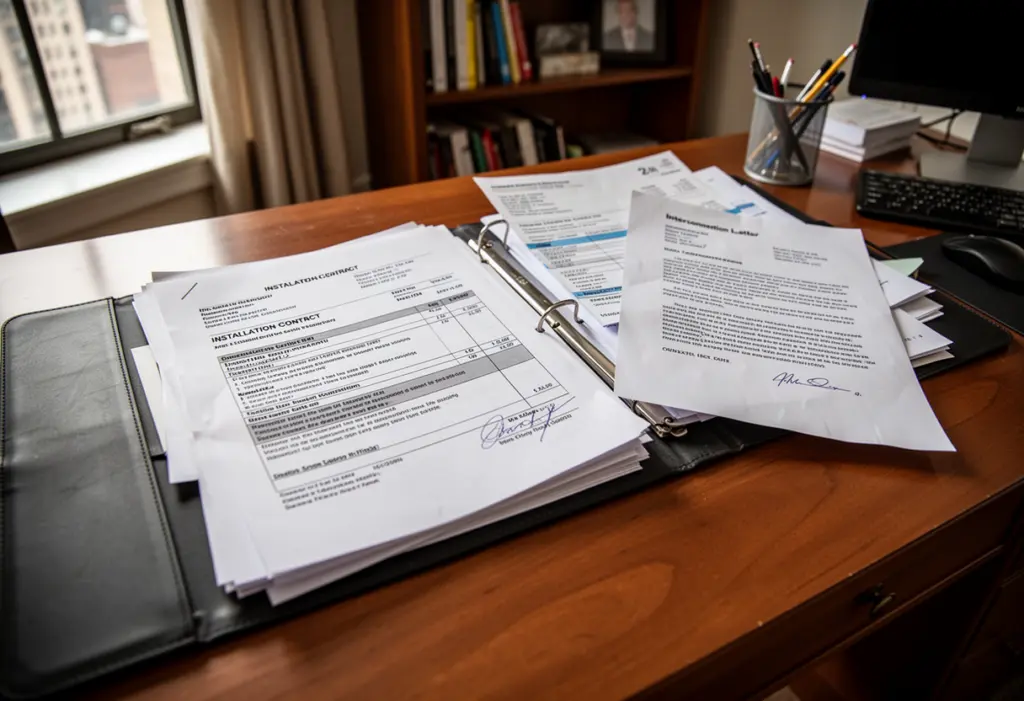
Solar paperwork outlives the filing it supports. New York’s credit can be carried forward for up to five years, a lease or power purchase agreement can generate a claim annually against a lifetime ceiling, and the property tax exemption runs for fifteen. That makes the document file a long-lived asset rather than a shoebox of receipts, and it is worth building deliberately in the month the system goes live, while everyone involved still answers the phone.
The core file
- The signed contract, including every change order. Change orders are the pages that go missing.
- An itemised invoice that separates equipment, labour, permits and any non-solar work such as a roof or a service upgrade. A single lump sum is the enemy of a clean credit calculation.
- Proof of payment for each instalment: statements or cleared payments, not just the invoice.
- The in-service evidence. Final inspection sign-off, the utility permission to operate letter and the meter exchange date. New York’s credit turns on when the equipment is placed in service, so this is the document that assigns your claim to a tax year.
- The interconnection paperwork, including your interconnection date. It fixes the start of the 20 year Phase One net metering term and determines whether the Customer Benefit Contribution applies to you at all, since that charge reaches systems interconnected on or after 1 January 2022.
If the system was completed in 2025
Keep one extra thing, and keep it findable: evidence of the date the original installation was completed. The repealed federal credit under section 25D turned on that moment rather than on placed in service, so a system finished in December 2025 and energised in January 2026 sits on the qualifying side of the line. An installer completion certificate, the final inspection date, or dated site photographs are the kind of evidence that supports it. Section 25D was terminated for expenditures made after 31 December 2025, so this is a one-time record for a closing window, not an ongoing filing habit.
If you lease or have a power purchase agreement
Two documents carry the whole claim, and both are easy to lose across a decade:
- The contract page showing the term. New York requires at least ten years for a lease and at least ten years for an agreement to buy the power. Without that page you cannot demonstrate you qualify.
- A running tally of what you have already claimed under that agreement. The $5,000 is a lifetime ceiling per agreement, and the form asks you to subtract prior years. Keep the number on one sheet at the front of the folder, updated each filing, and note that no credit is allowed after the fifteenth year of an agreement running longer than that.
Add the annual payment records, because for a lease the credit is computed from payments actually made that year, and for a power purchase agreement it is 25% of that year’s payments.
The non-income-tax documents people forget
The property tax exemption file. Keep your RPTL 487 application, the assessor’s determination and the year it starts. The exemption runs fifteen years on the added value where your municipality, your county and your school district have each declined to opt out — three separate bodies, so keep any correspondence that establishes which of them applies to you. If you live in New York City, Buffalo, Rochester, Syracuse or Yonkers, note that those five city school districts are fiscally dependent and levy no separate school tax, so there is no separate school check to document.
Permits and inspections. The building permit, the electrical permit and the inspection certificates. A future buyer’s attorney will ask, and a future roofer will want to know what is under the array.
Warranty documents for modules, inverter and workmanship, with the installer’s company details as they were at the time. Companies change hands.
Monitoring data. Export a production summary once a year. It is the only independent record of what the system did, and it is what makes a resale conversation factual.
How long to keep it
Longer than one filing season, and that is the point. A five year carryforward means the original invoice may still be supporting a return half a decade after the installation. A fifteen year property tax exemption and a twenty year net metering term both outlast the retention period most households apply to ordinary receipts. Ask your preparer for their retention rule for your situation and then keep the solar folder past it, because the documents are also the ones you hand to a buyer.
Scan everything and keep a copy off the house. The single most avoidable version of this problem is a homeowner selling in year eight who cannot produce the interconnection letter for a system nobody disputes exists.
The 2026 rules your file needs to reflect
Your folder should not contain, or rely on, a 30% federal line for a 2026 purchase. That credit is repealed. What it should support is New York’s 25% credit capped at $5,000 on Form IT-255 at your principal residence, non-refundable and limited by your state liability with a five year carryforward; the state sales tax exemption applied at purchase; and RPTL 487 for systems constructed before 1 January 2030. It should not show a NY-Sun or income-qualified Affordable Solar deduction on a 2026 purchase either. As of September 2026 NYSERDA has no open NY-Sun block for homes in any utility territory; check NYSERDA’s NY-Sun dashboard for a new one.
Keep one line in the folder for the running cost as well. A 9 kW system in Orange & Rockland territory pays a Customer Benefit Contribution of 9 x $1.00, exactly $9.00 a month or $108 a year, charged on DC capacity and recalculated annually rather than fixed at interconnection. Incentive rules change; check the current position at tax.ny.gov and nyserda.ny.gov each year you claim.
Frequently Asked Questions
What documents do I need for the New York solar credit?
The signed contract with change orders, an itemised invoice separating equipment and labour, proof of payment, and evidence of the date the equipment was placed in service such as the final inspection and permission to operate letter.
How long should I keep solar tax paperwork?
Longer than one season. The New York credit carries forward up to five years, the property tax exemption runs fifteen and net metering twenty, so the original invoice can support a return years later. Ask your preparer for their retention rule.
What extra record matters if my system was finished in 2025?
Evidence of the date the original installation was completed, such as a completion certificate or the final inspection date. The repealed federal credit turned on that moment rather than on when the system was switched on.
What should I keep if my panels are leased?
The contract page proving the term is at least ten years, annual payment records, and a running tally of amounts already claimed under that agreement, because the $5,000 is a lifetime ceiling per agreement.
This article is general information, not tax, legal or financial advice. Incentive amounts, eligibility rules and deadlines change and depend on your utility, your tax situation and your property. Confirm current terms with NYSERDA, your utility and a qualified tax professional before making a decision.
NY Solar Incentives
Independent New York solar research. We summarise NYSERDA, NY-Sun and federal programme rules from published sources and state plainly when a figure is an estimate. We are not a government agency and do not sell equipment.
Run the arithmetic on your own system
Check the dated program table and your arrangement before counting an incentive. Standard residential NY-Sun blocks are closed; Long Island Affordable Solar has a conditional income-verification route. The NY credit depends on qualified costs and tax liability, while the NYC abatement reduces future property-tax bills. The estimator keeps those timings separate.