What Drives Solar Panel Cost in Patchogue, NY
Two houses in Patchogue with the same roof area can carry very different solar prices. The reasons are local: who issues the permit, how close the bay is, and how many planes the roof has been broken into.
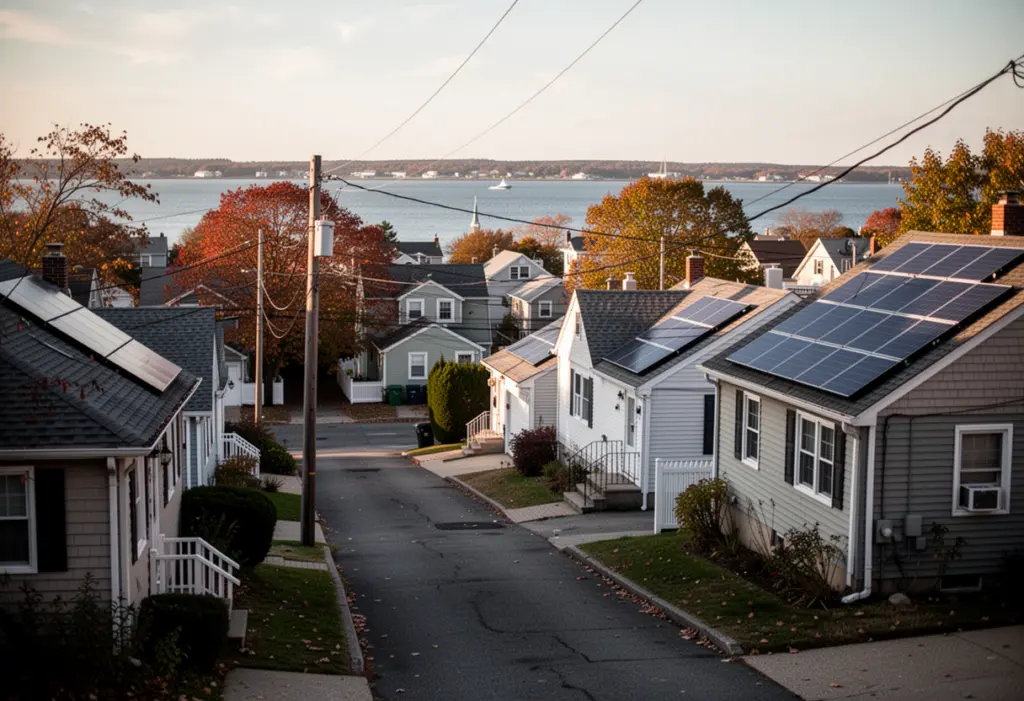
Two houses in Patchogue with the same roof area and the same 11772 ZIP code can carry very different solar prices, and the reasons are mostly local: who issues the permit, how close the property sits to the Great South Bay, how many planes the roof has been broken into, and what the electrical service can take. Anyone quoting a price per watt before walking the property is quoting an average rather than your house.
The permit comes from the village, not the town
Patchogue is an incorporated village inside the Town of Brookhaven, and that distinction is the first thing to establish, because an incorporated village generally issues its own building permits rather than leaving it to the surrounding town. An installer who mainly works in unincorporated Brookhaven may be unfamiliar with the village process, and unfamiliarity shows up as weeks rather than as dollars. Ask which authority having jurisdiction the application goes to, who signs the electrical inspection, and how many village applications that company has filed in the past year.
The NYS Unified Solar Permit standardises residential and small commercial solar permitting for systems of 25 kW DC and under and has been adopted by more than 300 authorities having jurisdiction across the state. Ask directly whether yours uses it rather than assuming that it does.
The bay is a cost driver
- Flood zone. Southern Patchogue sits on the Great South Bay, and where a property falls in a mapped flood zone the elevation of electrical equipment becomes a design question. Inverters, disconnects and any battery mounted low in a garage may have to move. Ask whether your parcel is in a mapped zone before the layout is drawn, not after.
- Coastal wind design. Racking on the south shore of Suffolk County is engineered for higher design wind speeds than an inland roof, which means more attachment points, more flashings and more labour, and it also means more roof penetrations that have to be sealed properly.
- Salt air. Ask what the manufacturer says about coastal exposure for the racking, the fasteners and any outdoor rated inverter or battery enclosure, and whether the warranty carries a coastal exclusion.
Roof complexity, not roof size
Price follows the number of separate roof planes far more closely than it follows square footage. A single unbroken south facing plane is the cheapest kilowatt you will ever buy. Dormers, additions, skylights, chimneys and a roof carved into four or five small faces mean more racking runs, more flashing, sometimes more inverters or optimisers, and a longer time on site. Village housing that has been extended over decades tends strongly toward the second pattern.
Two roof questions decide whether a quote is even valid: how old is the roof, and will it outlive the array. Putting panels on a roof with eight years left in it buys you a removal and reset later, which is a real cost you should price now rather than meet in year nine.
The electrical service
Older Long Island housing frequently runs a 100 amp service, and a solar breaker, an EV charger and a heat pump do not all fit behind it. A service upgrade is a genuine line item and it should be established at the site survey rather than discovered after signing. Ask for it priced separately, so that you can see what is solar and what is the house catching up with modern loads.
The charge that follows the size, not the price
Patchogue is served by PSEG Long Island, which operates the LIPA system across Nassau, Suffolk and the Rockaways. The Customer Benefit Contribution is billed monthly on the DC size of the array, regardless of what it produces, for systems interconnected on or after 1 January 2022. At the 2026 residential rate of $1.13 per kW-month, a 6.4 kW array pays 6.4 x $1.13 = $7.23 a month, about $87 a year. A 9 kW array on the same roof pays $10.17 a month instead. That is the running cost of oversizing, and it is charged whether or not you ever consume the extra production.
Note also that PSEG Long Island does not cover all of Suffolk and Nassau. The Village of Greenport and Fishers Island in Suffolk, and the villages of Freeport and Rockville Centre in Nassau, run their own municipal electric utilities, which sit outside Public Service Commission jurisdiction with no Customer Benefit Contribution and no state interconnection process. Confirm the utility named on your own bill.
2026 incentives, and what they are worth here
The 30% federal residential credit is gone for buyers. Section 25D was terminated for expenditures made after 31 December 2025, with an expenditure treated as made when the original installation is completed. A Patchogue quote in 2026 still showing a federal line is materially wrong.
What remains is worth having. New York’s 25% credit capped at $5,000 on Form IT-255 applies at your principal residence, and because it is capped, the cap bites on a larger system: at 25% the credit stops growing once qualified expenditure passes $20,000, so every kilowatt beyond that point is unsubsidised by the state. NY-Sun no longer comes off the contract price: as of September 2026 NYSERDA has no open NY-Sun block for homes in any utility territory; check NYSERDA’s NY-Sun dashboard for a new one. The state sales tax exemption covers residential solar equipment with localities electing separately on their own share, and RPTL 487 exempts the added value for 15 years where the village, the town, the county and the school district have each not opted out, provided you file form RP-487 with the assessor by the taxable status date and the system is constructed before 1 January 2030. In a village that is genuinely four enquiries: the Village of Patchogue, the Town of Brookhaven, Suffolk County and your school district. Ask the assessor, and check the current position with NYSERDA before you sign, because these programmes change.
Frequently Asked Questions
What determines solar panel cost in Patchogue?
Roof complexity and age, whether the electrical service needs upgrading, coastal wind and flood zone requirements near the Great South Bay, and which authority issues the permit. The number of separate roof planes matters more than square footage.
Who issues the solar permit in Patchogue?
Patchogue is an incorporated village inside the Town of Brookhaven, so the village generally issues its own building permits. Ask your installer which authority they will file with and how recently they have done it.
Which utility serves Patchogue?
PSEG Long Island, which operates the LIPA system across Nassau, Suffolk and the Rockaways. Greenport, Fishers Island, Freeport and Rockville Centre run their own municipal electric utilities and sit outside it.
How much is the monthly capacity charge?
The Customer Benefit Contribution is $1.13 per kW-month for PSEG Long Island residential customers in 2026, so a 6.4 kW array pays about $7.23 a month, roughly $87 a year, regardless of production.
This article is general information, not tax, legal or financial advice. Incentive amounts, eligibility rules and deadlines change and depend on your utility, your tax situation and your property. Confirm current terms with NYSERDA, your utility and a qualified tax professional before making a decision.
NY Solar Incentives
Independent New York solar research. We summarise NYSERDA, NY-Sun and federal programme rules from published sources and state plainly when a figure is an estimate. We are not a government agency and do not sell equipment.
Run the arithmetic on your own system
Check the dated program table and your arrangement before counting an incentive. Standard residential NY-Sun blocks are closed; Long Island Affordable Solar has a conditional income-verification route. The NY credit depends on qualified costs and tax liability, while the NYC abatement reduces future property-tax bills. The estimator keeps those timings separate.