What Solar Panels Cost in Warwick, New York
In Warwick the price starts with two questions you can answer yourself: which utility is printed on your bill, and which of four permitting authorities covers your address.
In Warwick the answer to what solar costs begins with two questions the homeowner can settle before anyone visits: which utility is printed on your bill, and which of four permitting authorities covers your address. Orange County is split between two utilities whose monthly capacity charges differ by roughly two thirds, and the Town of Warwick contains three incorporated villages, each with its own building department.
Two utilities, two different monthly charges
Orange & Rockland serves much of the Warwick area, while Central Hudson serves other parts of Orange County. Boundaries do not follow town or county lines, so the bill is the only reliable evidence of which one applies to you. For 2026 the residential Customer Benefit Contribution is $1.00 per kW-month for Orange & Rockland and $1.67 for Central Hudson, charged on DC system size rather than on production, and payable only on systems interconnected on or after 1 January 2022.
On a 10 kW array that is $10.00 a month against $16.70 a month — about $120 a year against roughly $200 — for identical hardware on identical roofs. Which of the two bills your address is fixed by where the service boundary runs rather than by anything in a proposal, and it is not a detail an installer should be settling on your behalf — establish it from your own bill before you settle on a system size.
Four authorities in one town
The Town of Warwick contains the villages of Warwick, Florida and Greenwood Lake, and a village address is permitted by its village rather than by the town. The 10990, 10921 and 10925 ZIP codes broadly track those communities, but a mailing address is not a jurisdiction — confirm yours from the assessment record. Then ask the office that will actually issue the permit whether it uses the New York State Unified Solar Permit for systems of 25 kW DC and under, and what the queue looks like at the moment.
Ground mounts, ridges and barns
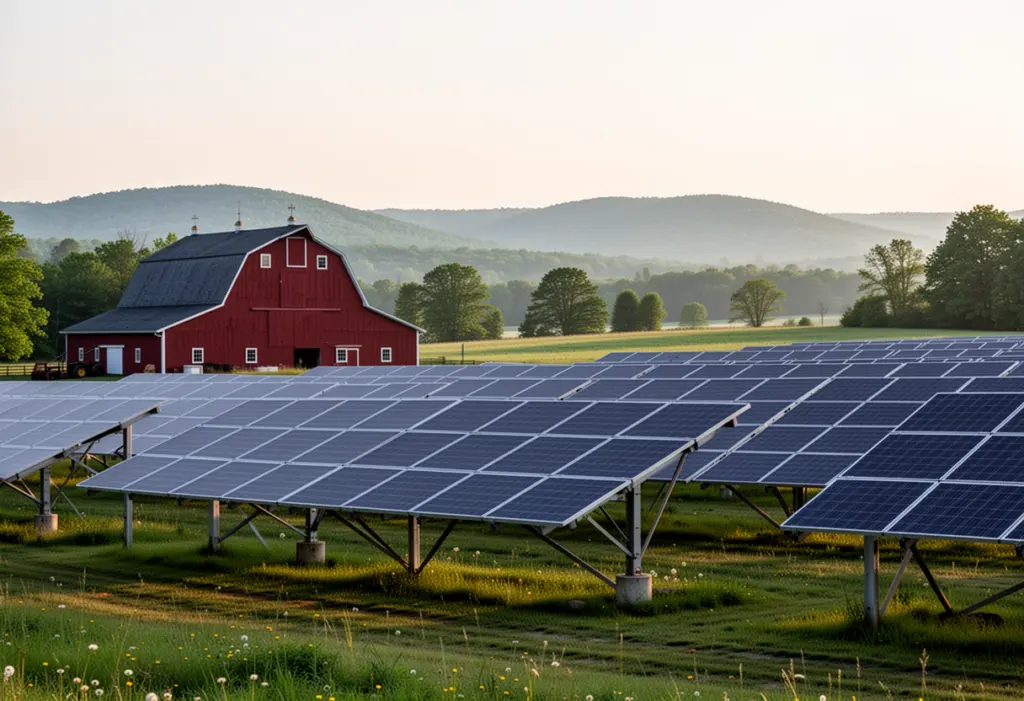
Warwick has land for ground-mounted arrays that a village lot never will, and the cost structure is different. Racking and foundations replace roof mounting, a trench has to reach back to the service, and the longer that run the more it costs. Against that: no roof age to work around, no reroofing sequence to plan, easier access for maintenance, and the freedom to point the array at the sun rather than at whichever way the house faces. Ridge lines near Greenwood Lake matter as well — ask for a horizon profile taken from the site rather than an assumed flat one.
A working farm is a different tax question altogether. Business and farm projects fall under a different provision from the residential section 25D, and the arrangements open to a farm are not the ones described on residential pages. Take that to your own accountant rather than to a salesperson, and do not let a residential proposal quote a business credit at you as though the two were interchangeable.
The 2026 incentive position
Residential federal support has ended. Section 25D was terminated for expenditures made after 31 December 2025, with the expenditure treated as made when the original installation is completed, so a residential purchase in Warwick this year claims nothing federally at all.
New York State continues. The IT-255 credit gives 25% of qualifying cost up to a ceiling of five thousand dollars at a principal residence, and it reaches leases and power purchase agreements of ten years or more — a shorter agreement does not qualify, however it is described in a sales pitch. NY-Sun, which a contractor used to apply as a price reduction, is not available to homes at present: as of September 2026 NYSERDA has no open NY-Sun block for homes in any utility territory, so a NY-Sun figure quoted to a neighbour last year is not one you will get; check NYSERDA’s NY-Sun dashboard for a new block. The state sales tax exemption covers residential equipment. RPTL 487 exempts the added assessed value for fifteen years subject to three separate opt-out checks — the town or village, Orange County, and your school district — and it requires the system to be constructed before 1 January 2030.
Confirm each of those with the assessor, check on the day you sign whether NYSERDA has opened a new NY-Sun block for homes, and read your own bill for the utility name. These programmes move, and last season’s answer is not evidence about this one.
Frequently Asked Questions
Which utility serves Warwick, NY?
Orange and Rockland serves much of the Warwick area while Central Hudson serves other parts of Orange County, and the boundary does not follow town lines. The name printed on your own bill is the only reliable evidence.
How much does the utility charge for the system each month?
For 2026 the residential Customer Benefit Contribution is $1.00 per kW-month with Orange and Rockland and $1.67 with Central Hudson. On a 10 kW array that is $10.00 a month against $16.70, or about $120 a year against roughly $200.
Who issues a solar permit in the town of Warwick?
The town for addresses outside a village, and the villages of Warwick, Florida or Greenwood Lake for addresses inside them. Confirm your jurisdiction from the assessment record, since a mailing address does not establish it.
Do farm solar projects get the same incentives as houses?
No. Business and farm projects fall under a different provision from the residential section 25D, and the residential rules described on consumer pages do not carry across. Take the question to your own accountant before signing anything.
This article is general information, not tax, legal or financial advice. Incentive amounts, eligibility rules and deadlines change and depend on your utility, your tax situation and your property. Confirm current terms with NYSERDA, your utility and a qualified tax professional before making a decision.
NY Solar Incentives
Independent New York solar research. We summarise NYSERDA, NY-Sun and federal programme rules from published sources and state plainly when a figure is an estimate. We are not a government agency and do not sell equipment.
Run the arithmetic on your own system
Check the dated program table and your arrangement before counting an incentive. Standard residential NY-Sun blocks are closed; Long Island Affordable Solar has a conditional income-verification route. The NY credit depends on qualified costs and tax liability, while the NYC abatement reduces future property-tax bills. The estimator keeps those timings separate.