Solar Panel Cost in Ossining, NY: Shade Is the Line Item
Ossining is a hillside village under a heavy oak canopy, and shade is the item that decides its solar quotes. It also interacts badly with a utility charge billed on the size of the array rather than on what the array makes.
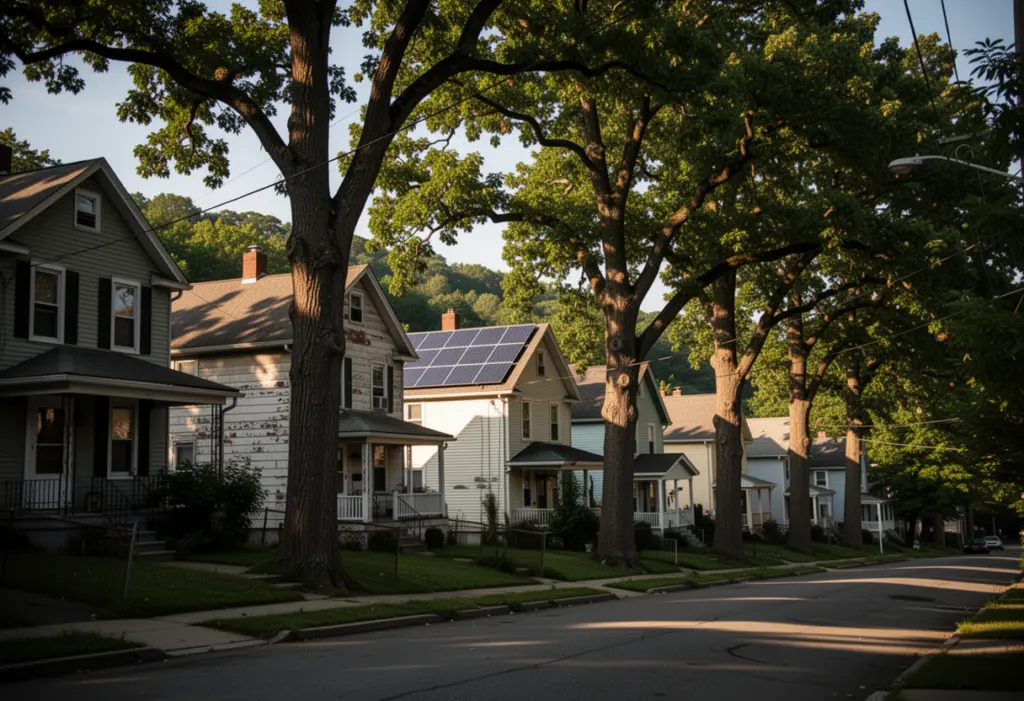
Ossining, ZIP code 10562, runs down a steep slope to the Hudson in northern Westchester County, inside Con Edison territory. Most solar quotes here differ from each other for one reason before any other: how much of the roof the trees have. Understanding what shade actually costs, and how it multiplies against a charge billed on system size, is worth more than comparing module datasheets.
Village or town, and which one is yours
The Village of Ossining and the Town of Ossining are separate authorities with separate building departments, and part of the Village of Briarcliff Manor lies within the town as well. A 10562 mailing address does not settle it. Confirm the jurisdiction of your parcel before an installer files anything, ask whether that department uses the New York State Unified Solar Permit for systems of 25 kW DC and under, and ask whether your address falls inside a locally designated historic area, because where design review applies it precedes the building permit.
What a mature oak actually costs you
The older parts of the village sit under a heavy hardwood canopy, and the trees are frequently taller than the houses and on a neighbour’s land. Three consequences follow, in ascending order of expense.
- Measurement. A satellite-derived estimate cannot see a canopy edge correctly. Insist on a shade assessment measured at roof level, with the December and January figures shown separately rather than folded into an annual total.
- Tree work. Removing or crown-lifting a large hardwood is a separate trade at a separate price, and it is not inside a solar quote unless it says so. A tree on a neighbour’s property is a conversation, not a line item.
- Compensating with capacity. The usual response to shading is a bigger array to reach the same annual output. That is where Ossining arithmetic turns against you.
Why shade and the Con Edison charge multiply
The Customer Benefit Contribution applies to systems interconnected on or after 1 January 2022 and is calculated from the DC size of the array, not from what it generates. Con Edison’s 2026 residential rate is $1.29 per kW-month; read the supplier name off your own bill rather than inferring it from the address. A 10 kW system pays $12.90 a month, about $155 a year.
Now suppose two of those ten kilowatts exist only to make up for shaded output. They still cost $2.58 every month, roughly $31 a year, on top of what you paid to buy and install them, and they contribute least exactly when the shading is worst. Capacity you added to fight shade is capacity you pay a fixed monthly fee on. That is the uncomfortable sentence in every heavily shaded Ossining proposal, and it is why the right answer here is sometimes a smaller array than the one that covers your whole bill.
Set against it, Phase One net metering credits exports at the full retail rate and holds for 20 years from interconnection, so a well-sited array in the same village does very well. The gap between the two houses is trees, not equipment.
Hillside streets and old roofs
Access is a real cost here. Steep driveways, retaining walls and narrow streets slow delivery and staging before any work begins, and a crew day is the biggest labour line in a residential quote. The housing stock is largely early twentieth century and earlier, which brings slate and steep pitch into the conversation along with 100 amp electrical service that may not take a solar breaker without an upgrade or a line-side connection. Have the panel rating and busbar capacity checked at the property and written into the price before you sign, not raised afterwards.
When the honest answer is not a rooftop array
If the assessment shows the roof is genuinely compromised, say by the canopy across the street rather than by anything on your own land, community solar deserves a straight comparison. It needs no roof, no permit and no capital, and subscribers pay no Customer Benefit Contribution at all. A shaded Ossining roof plus a large array is frequently a worse financial position than no array and a subscription, and an installer paid to sell arrays is not the person who will volunteer that.
Incentives as they stand in 2026
The 30% federal residential credit was terminated for expenditures made after 31 December 2025, with an expenditure treated as made when the original installation is completed. Nothing federal is available to a homeowner buying a system in Ossining this year, and a proposal claiming otherwise is wrong on its face.
Most of the state package is intact. New York’s 25% credit capped at $5,000 on Form IT-255 applies to a principal residence and is limited by your actual state tax liability, with unused credit carried forward up to five years. NY-Sun, which reaches you as a contractor-applied price reduction when a block is open, is the exception: as of September 2026 NYSERDA has no open NY-Sun block for homes in any utility territory; check NYSERDA’s NY-Sun dashboard for a new one. The sales tax exemption applies to residential equipment. And RPTL 487 exempts the added value for 15 years where the village or town, Westchester County and the school district have each not opted out, for construction completed before 1 January 2030. Confirm each one at its own source, tax.ny.gov for the credit and nyserda.ny.gov for NY-Sun, close to the date you sign.
Frequently Asked Questions
How much does shade cost an Ossining solar system?
More than the lost kilowatt-hours. The usual fix is a larger array, and every extra kilowatt pays the Con Edison capacity charge of $1.29 per kW-month whether it produces or not, which is about $31 a year for two kilowatts added to fight shade.
Is tree removal included in a solar quote?
Almost never. Tree work is a separate trade at a separate price, and a tree on a neighbour's property is a negotiation rather than a line item. Get the shading measured at roof level before deciding anything.
Do I file my solar permit with the village or the town of Ossining?
It depends on the parcel. The Village of Ossining and the Town of Ossining are separate authorities with separate building departments, and part of Briarcliff Manor sits inside the town. A 10562 address does not settle it.
Is community solar a reasonable alternative on a shaded roof?
Often, yes. It needs no roof, no permit and no capital, and subscribers pay no Customer Benefit Contribution at all. On a heavily shaded roof it can leave you better off than a large compensating array.
This article is general information, not tax, legal or financial advice. Incentive amounts, eligibility rules and deadlines change and depend on your utility, your tax situation and your property. Confirm current terms with NYSERDA, your utility and a qualified tax professional before making a decision.
NY Solar Incentives
Independent New York solar research. We summarise NYSERDA, NY-Sun and federal programme rules from published sources and state plainly when a figure is an estimate. We are not a government agency and do not sell equipment.
Run the arithmetic on your own system
Check the dated program table and your arrangement before counting an incentive. Standard residential NY-Sun blocks are closed; Long Island Affordable Solar has a conditional income-verification route. The NY credit depends on qualified costs and tax liability, while the NYC abatement reduces future property-tax bills. The estimator keeps those timings separate.