Solar Panel Cost in Nyack, NY: The Village Roof Problem
Nyack roofs are steep, cut up by dormers and often slate, which raises the cost of every kilowatt installed on them. The compensation is that Orange and Rockland charges less per kilowatt than almost anyone in the state.
On this page 7 sections
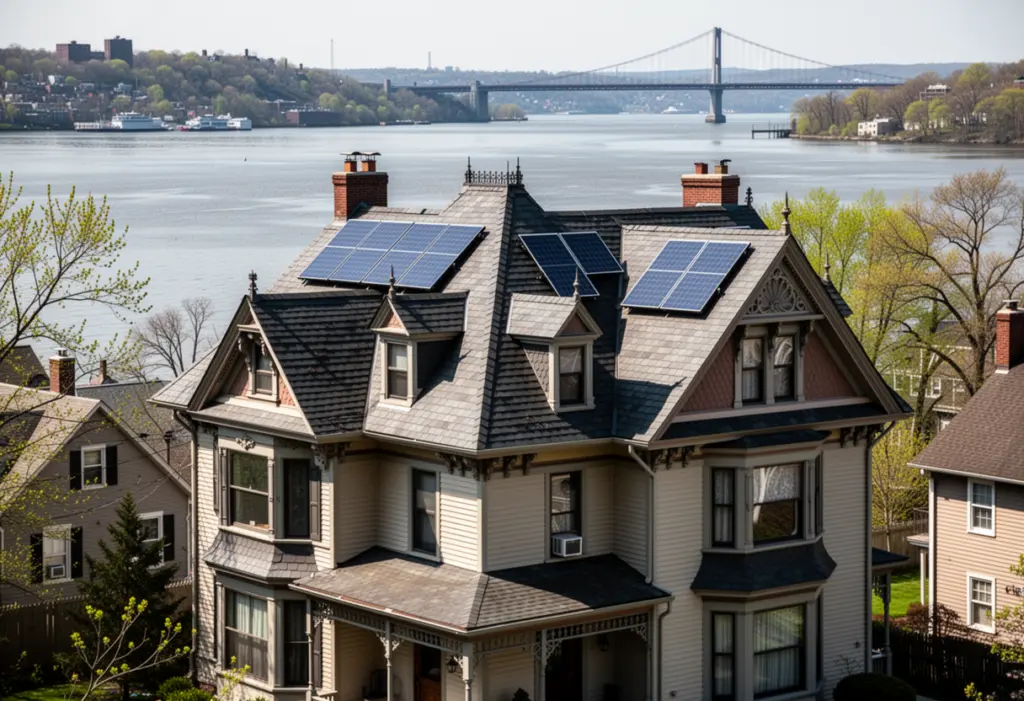
Nyack, ZIP code 10960, sits on the Rockland County shore at the widest reach of the Hudson, in Orange & Rockland territory. Two things drive the cost of an array here in opposite directions. The housing is Victorian, which makes the installation labour-intensive, and the utility charges among the lowest capacity fees in New York, which makes owning the finished system cheap. A quote that ignores either is not describing your house.
Three answers to the question of who issues your permit
A Nyack address is not automatically a Village of Nyack address. The Village of Nyack and the Village of Upper Nyack are separate incorporated villages with their own building departments. South Nyack no longer exists as a village: it voted to dissolve and the dissolution took effect on 31 March 2022, so parcels in the former village are now administered by the Town of Orangetown. Anyone working from an older list of local authorities will send your application to a village that has not existed for four years.
Establish the correct authority first, then ask it whether it uses the New York State Unified Solar Permit for systems of 25 kW DC and under, and whether your address falls under architectural or historic review. In the villages here that review is a real stage of the process and it comes before the building permit.
Why a Victorian roof costs more per kilowatt
The older streets carry steep pitches, turrets, dormers, cross-gables and slate. The panels cost the same as they do on a 1985 ranch. Everything else does not:
- Broken roof planes. A cut-up roof takes several small sub-arrays instead of one rectangle, which means more racking runs, more flashing, more wiring and more inverter or optimiser hardware for the same total output.
- Pitch and height. Steep and tall means staging, fall protection and slower work. That is crew days, and crew days are the largest labour item in any residential quote.
- Slate. It can be done well and it is not a reason to abandon the project, but it needs an installer who can show you finished penetrations on slate rather than describe them.
- Old framing. An engineer’s letter is far more likely on nineteenth-century construction than on a modern truss roof. Price it in rather than discovering it after contract.
Ask for the price as a gross figure before any incentive, and as dollars per watt of DC capacity. On a complex roof those two numbers are the only way to compare one proposal with another honestly.
The river is east and the hill is west
Nyack climbs steeply from the waterfront. Open sky over the river gives excellent morning sun, and the ground rising to the west shortens the afternoon on the lower streets. Hook Mountain closes part of the northern horizon further up the shore, which matters less for a south-facing array but does affect east and west facing planes. Mature street trees on the older blocks do the rest.
The remedy is the same everywhere and it is cheap: insist on a shade assessment measured at the roof, and ask what the model assumes for December and January rather than accepting an annual total.
Orange and Rockland has the arithmetic you want
Systems interconnected on or after 1 January 2022 pay a Customer Benefit Contribution calculated from DC system size, not from generation. The 2026 residential rate for Orange & Rockland is $1.00 per kW-month exactly, which makes the sum trivial once you have confirmed from your own bill that Orange & Rockland is the company serving your meter: a 9 kW array pays $9.00 a month, $108 a year. The same array across the river in Con Edison territory pays $11.61 a month, and in Central Hudson territory further north $15.03. That difference is decided by geography alone, and it runs for as long as you own the system, though the rates are recalculated annually rather than locked in.
Phase One net metering runs the other way, crediting exports at the full retail rate under a structure that holds for 20 years from the date you interconnect. On a Victorian roof broken into several small planes, that is what rescues the economics of the sections facing the wrong way.
In a village, the property tax question has four parts
RPTL 487 exempts the added value of a solar system from property tax for 15 years, but only where the taxing jurisdiction has not opted out, and the opt-out is available to a county, city, town or village by local law and to a school district by resolution. An incorporated village parcel is taxed by the village and the town as well as by Rockland County and the school district. That is four checks rather than the three a general New York guide will tell you to make. Ask each of them, get it in writing, and note that section 487 also requires construction to be completed before 1 January 2030.
2026 in one paragraph
The federal residential credit is gone for anything completed after 31 December 2025, and the test is completion of the original installation, not the date the meter is swapped. What is live is the New York 25% credit capped at $5,000 on Form IT-255 for your principal residence, which also reaches leases and power purchase agreements running ten years or more, the state sales tax exemption, and section 487 above. NY-Sun, applied through your contractor when a block is open, is not live: as of September 2026 NYSERDA has no open NY-Sun block for homes in any utility territory; check NYSERDA’s NY-Sun dashboard for a new one. Check the current position yourself at tax.ny.gov and nyserda.ny.gov before you sign anything, because incentives are revised on their own schedule and not on yours.
Frequently Asked Questions
Who issues a solar permit for a former South Nyack address?
The Village of South Nyack dissolved with effect from 31 March 2022, so those parcels are now administered by the Town of Orangetown. Nyack and Upper Nyack remain separate villages with their own building departments.
Why is solar more expensive on an older Nyack house?
Steep pitches, dormers and cross-gables split the roof into several small sub-arrays, which multiplies racking, flashing and wiring. Slate work, staging and a structural letter on nineteenth-century framing add to it.
What does Orange and Rockland charge for a solar system?
The 2026 residential Customer Benefit Contribution is $1.00 per kW-month of DC size, so a 9 kW array pays $9.00 a month, $108 a year. It applies to systems interconnected on or after 1 January 2022 and is reset annually.
How many opt-out checks does a village address need for RPTL 487?
Four. A village parcel is taxed by the village, the town, the county and the school district, and each of them can opt out of the exemption separately. Ask all four and get the answers in writing.
This article is general information, not tax, legal or financial advice. Incentive amounts, eligibility rules and deadlines change and depend on your utility, your tax situation and your property. Confirm current terms with NYSERDA, your utility and a qualified tax professional before making a decision.
NY Solar Incentives
Independent New York solar research. We summarise NYSERDA, NY-Sun and federal programme rules from published sources and state plainly when a figure is an estimate. We are not a government agency and do not sell equipment.
Run the arithmetic on your own system
Check the dated program table and your arrangement before counting an incentive. Standard residential NY-Sun blocks are closed; Long Island Affordable Solar has a conditional income-verification route. The NY credit depends on qualified costs and tax liability, while the NYC abatement reduces future property-tax bills. The estimator keeps those timings separate.