Solar Panel Cost in New Paltz, NY: What Sets the Number
In New Paltz the panels are the predictable part. Which building department holds your parcel, whether your roof faces historic review, and how much western sky the Shawangunk Ridge already owns are what move the price.
On this page 8 sections
- 01There are two New Paltzes, and they issue their own permits
- 02Historic review happens before the building permit
- 03The ridge takes the end of your afternoon
- 04Low ground along the Wallkill
- 05Who is actually paying the bill the array offsets
- 06Central Hudson charges the most per kilowatt in the state
- 07What is left in 2026
- 08Frequently Asked Questions
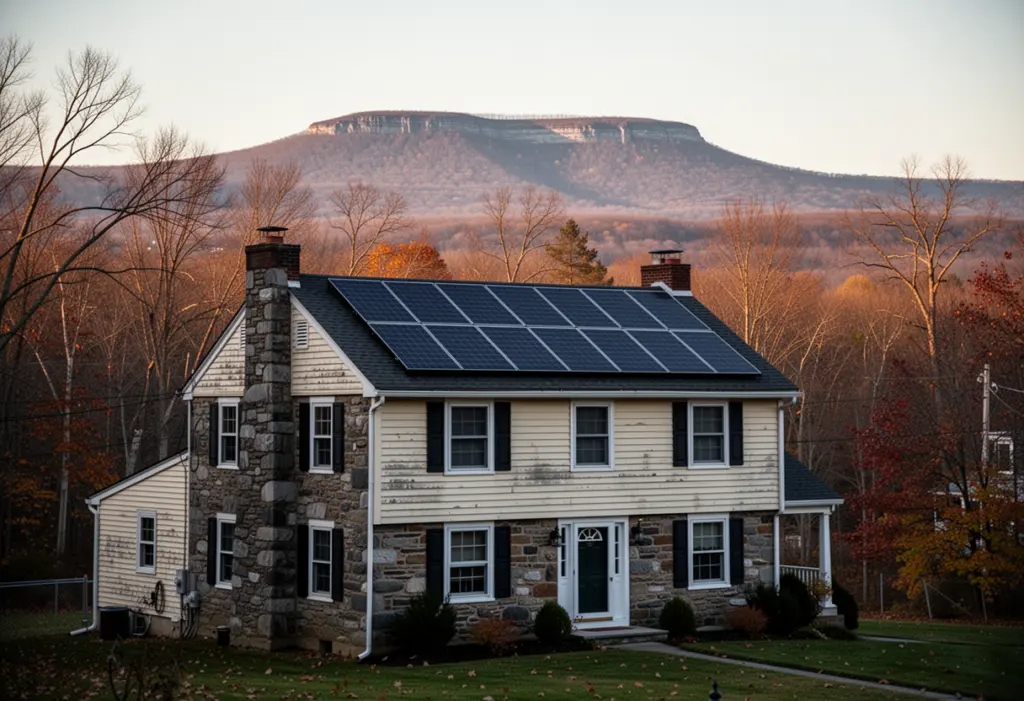
New Paltz sits in Ulster County on the Wallkill River, under the eastern face of the Shawangunk Ridge, ZIP code 12561. Panels and inverters are priced in a national market and vary little from town to town. What varies here is everything around them, and in New Paltz it comes down to three local questions: which of two building departments holds your parcel, whether your roof faces architectural review before it faces an inspector, and how much of your western sky the ridge has already taken.
There are two New Paltzes, and they issue their own permits
The Village of New Paltz and the Town of New Paltz are separate municipalities with separate building departments. A 12561 mailing address tells you nothing about which one covers your house. Settle that before an installer files anything, because a permit lodged with the wrong authority is weeks, not hours.
Residential systems of 25 kW DC and under fall inside the scope of the New York State Unified Solar Permit, which standardises the application across the authorities that have adopted it. Ask your building department directly whether it uses that form. Ask as well what the fee schedule is and how long a complete application currently takes, and get both answers before you sign, not after.
Historic review happens before the building permit
New Paltz holds a nationally designated concentration of early stone houses on and around Huguenot Street, and older blocks nearby carry protected character too. Where architectural or landmarks review applies, it sits ahead of the building permit: the design is judged first, and the outcome can rule out the roof plane the installer wanted.
Two practical consequences. First, find out whether your address falls inside a designated area before contract, and design for approval rather than appealing a refusal. Street-visible placement is what draws objection, so a rear plane, flush mounting that follows the existing pitch, dark frames and concealed conduit resolve most applications on their own. Second, ask how often the reviewing board sits. A monthly meeting means a missed submission date costs four weeks, and four weeks matters for the reason set out at the end of this page.
The ridge takes the end of your afternoon
West of the village the Shawangunk Ridge rises several hundred feet in a single line. On parcels close under it, the sun disappears behind rock well before it would reach a flat horizon, and the loss falls on late-afternoon production every day of the year. Nothing on a satellite-derived estimate captures that reliably.
So ask for a measured shade assessment taken at roof level, with a horizon profile, rather than a modelled figure produced from imagery. Then ask what the model assumes for December and January specifically, instead of accepting an annual total. A number that is wrong about winter is wrong about the months your bill is highest.
Low ground along the Wallkill
Parts of the low ground beside the Wallkill sit in mapped flood zones. Where yours does, the inverter, the disconnects, the production meter and any battery generally have to be mounted above a specified elevation. That rules out the basement, which is the obvious place to put one, and it is a design constraint rather than an optional upgrade.
Who is actually paying the bill the array offsets
A large share of housing here is rented, and a rented house raises a question a quote will not ask. An array is interconnected behind one meter and reduces one account. If your tenant holds the electric account, the savings land on the tenant while the capital cost and the monthly capacity charge land on you. Decide which account the system serves before anything is designed, and if you own the property but do not live in it, read the state credit rule below carefully.
Central Hudson charges the most per kilowatt in the state
Every rooftop system interconnected on or after 1 January 2022 pays a Customer Benefit Contribution, calculated from the DC size of the array rather than from what it generates. Central Hudson’s 2026 residential figure is $1.67 per kW-month, the highest residential rate of any utility in New York. Take the supplier name off your own bill before you apply that rate, because territory boundaries in the mid-Hudson do not follow town lines. A 7.5 kW array pays $12.53 a month, roughly $150 a year. Take it to 12 kW and it is $20.04 a month, close to $240 a year, whether or not the ridge lets those extra panels produce.
The rates are reset annually and are not fixed at interconnection, so today’s figure is a planning number rather than a promise. Running the other way, Phase One net metering credits your exports at the full retail rate and holds that structure for 20 years from interconnection.
What is left in 2026
The 30% federal residential credit is gone. Section 25D was terminated for expenditures made after 31 December 2025, and an expenditure is treated as made when the original installation is completed. Any New Paltz proposal still carrying a 30% federal line is materially wrong, and the rest of its arithmetic deserves the same scrutiny.
New York’s own 25% credit, capped at $5,000 on Form IT-255, survives and reaches leases and power purchase agreements of ten years or more as well as outright purchase. It requires the system to serve your principal residence in New York, which is exactly why a landlord with a student rental on the other side of the village cannot claim it on that roof. Alongside it sit the state sales tax exemption and the RPTL 487 property tax exemption on the added value where the village or town, Ulster County and the school district have each declined to opt out, with construction completed before 1 January 2030. NY-Sun, applied by your contractor as a price reduction when a block is open, is not among them for now. As of September 2026 NYSERDA has no open NY-Sun block for homes in any utility territory; check NYSERDA’s NY-Sun dashboard for a new one. Every one of these can be checked yourself at tax.ny.gov and nyserda.ny.gov, and every one of them can move between your quote and your installation.
Frequently Asked Questions
Why does solar cost more on some New Paltz houses than others?
The array is the stable part of the price. Historic review that forces a particular roof plane, a structural letter on old framing, a service panel upgrade, tree or ridge shading that pushes you to a larger system, and flood-zone equipment elevation are the items that move the total.
Does the Shawangunk Ridge affect solar production?
On parcels close under it, yes. The sun sets behind the ridge earlier than it would behind a flat horizon, so late-afternoon output is lost year round. Ask for a shade assessment measured at roof level rather than a satellite estimate.
Which building department issues my solar permit in New Paltz?
The Village of New Paltz and the Town of New Paltz are separate authorities with separate building departments, and a 12561 address does not tell you which. Confirm the jurisdiction of your parcel before an installer files.
What does Central Hudson charge for having solar?
The 2026 residential Customer Benefit Contribution is $1.67 per kW-month of DC size, the highest residential rate in the state. A 7.5 kW system pays about $12.53 a month, roughly $150 a year, and the rate is recalculated annually.
This article is general information, not tax, legal or financial advice. Incentive amounts, eligibility rules and deadlines change and depend on your utility, your tax situation and your property. Confirm current terms with NYSERDA, your utility and a qualified tax professional before making a decision.
NY Solar Incentives
Independent New York solar research. We summarise NYSERDA, NY-Sun and federal programme rules from published sources and state plainly when a figure is an estimate. We are not a government agency and do not sell equipment.
Run the arithmetic on your own system
Check the dated program table and your arrangement before counting an incentive. Standard residential NY-Sun blocks are closed; Long Island Affordable Solar has a conditional income-verification route. The NY credit depends on qualified costs and tax liability, while the NYC abatement reduces future property-tax bills. The estimator keeps those timings separate.