Solar Panel Cost in Hicksville, NY: A Postwar Roof Problem
In Hicksville the two things that decide your solar price are the age of the roof under the array and whether the service panel can take another breaker.
On this page 7 sections
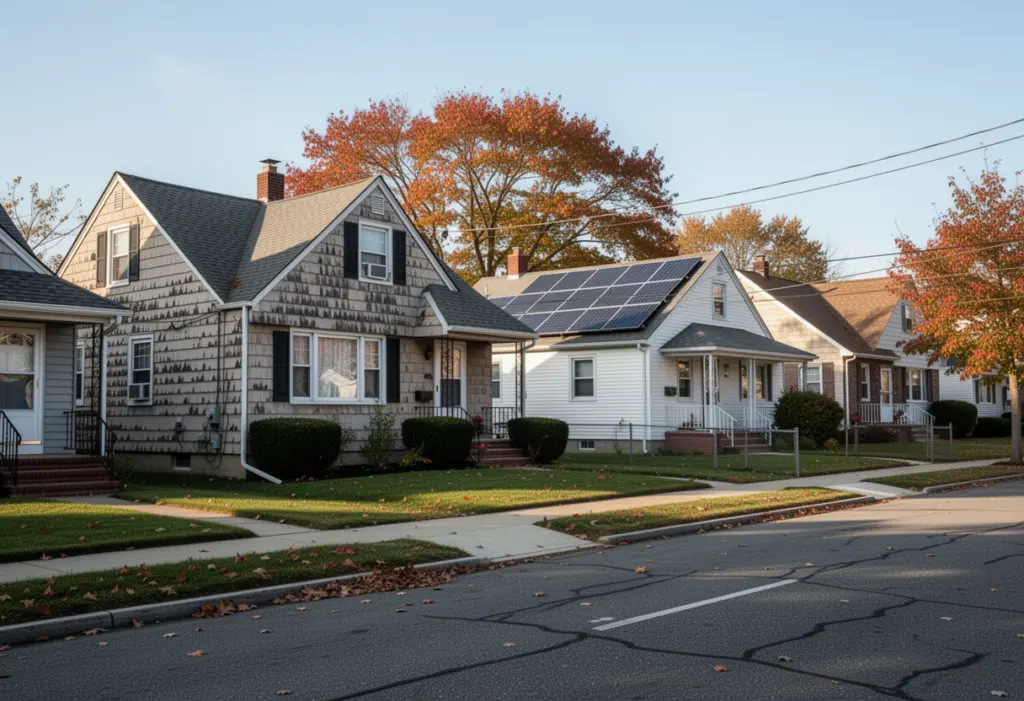
Hicksville is a hamlet in the Town of Oyster Bay, mostly inside the 11801 postal area, and its housing stock tells you where the money in a solar quote actually goes. These are postwar houses on small lots, and the two variables that dominate a price here are the age of the roof and the capacity of the electrical service.
Replace the roof first, or pay the labour twice
The original roofs on this housing are long gone, but the coverings that replaced them are now themselves aging. If your roof is within a few years of replacement, put the roof first. Removing an array and reinstalling it later is a separate job with its own labour bill, its own crane or lift where the pitch demands it, and its own re-inspection, and no part of that second bill is covered by anything the solar contractor promised the first time.
Ask for the roof age to be written into the proposal, along with what happens if rotten decking is found once the array comes off years from now. A vague answer to that question is itself information.
Service capacity, and the pile-up behind it
Many houses of this vintage are still on a 100 amp service. A solar breaker on its own may fit. A solar breaker plus an EV charger, or plus a heat pump, frequently does not. Electrification is cumulative and every addition lands on the same panel, so decide the whole plan now and price the service upgrade once, rather than discovering it between two projects.
Small roof planes are the other constraint
- Capes and expanded ranches have modest planes broken by vents, plumbing stacks and dormers, so panel count is limited by geometry before it is limited by budget.
- Additions and enclosed porches often sit on framing that was never rated for a distributed load. Ask whether a structural letter is required and who pays for it.
- Where the good plane faces east or west, production per panel falls and the array has to grow to hit the same annual figure, which raises both the price and the monthly capacity charge.
The monthly charge nobody mentions at the kitchen table
Hicksville is served by PSEG Long Island, which operates the LIPA system, and the utility name printed on your own bill is what settles it. The Customer Benefit Contribution is billed on DC system size and not on output. The 2026 residential rate is $1.13 per kW-month, so an 8 kW array pays 8 x $1.13 = $9.04 a month, about $108 a year. It applies to systems interconnected on or after 1 January 2022, and the rate is recalculated annually rather than fixed for the life of the system. Ask to see it written into whatever payback estimate you are shown, because a payback that ignores a recurring charge is not a payback.
On the credit side, exports run under Phase One net metering at the full retail rate, and that arrangement holds for 20 years from interconnection.
Sales tax and property tax
New York exempts residential solar energy system equipment from state sales tax, and localities may separately elect to exempt their local share, so the total exemption is not uniform across the state. Ask for the sales tax line to be shown explicitly on the proposal and ask which portion is exempt.
For property tax, RPTL 487 gives a 15 year exemption on the added value of the system, but it requires three separate confirmations because a county, city, town or village may opt out by local law and a school district may opt out by resolution. In Hicksville that means Nassau County, the Town of Oyster Bay, and the school district covering your address. The system must also be constructed before 1 January 2030 to be within the section at all.
What is actually available in 2026
New York’s 25 percent credit, capped at $5,000, on Form IT-255, remains the largest thing a Hicksville homeowner claims directly, provided the equipment is installed and used at the taxpayer’s principal residence in New York, which rules out a rental or a second property, and the cap is reached at $20,000 of qualified expenditure. NY-Sun no longer comes off the price here: the last Long Island residential block closed on 17 April 2016. As of September 2026 NYSERDA has no open NY-Sun block for homes in any utility territory; check NYSERDA’s NY-Sun dashboard for a new one. The federal 30 percent residential credit no longer exists for a 2026 purchase: section 25D ended for expenditures made after 31 December 2025, and an expenditure is treated as made when the original installation is completed. Every one of these programmes can change, so verify at tax.ny.gov and nyserda.ny.gov before you commit.
Frequently Asked Questions
Should I replace my roof before installing solar in Hicksville?
If the roof is within a few years of replacement, yes. Removing and reinstalling an array later is a separate job with its own labour and inspection costs, and none of it is covered by the original installation.
Will a 100 amp service handle solar in an older Hicksville house?
Solar alone may fit. Solar plus an EV charger or a heat pump frequently does not. Decide the whole electrification plan first so the service upgrade is priced once rather than twice.
What does the capacity charge cost on an 8 kW system?
At the 2026 PSEG Long Island residential rate of $1.13 per kW-month, an 8 kW system pays $9.04 a month, about $108 a year, billed on DC size regardless of how much it produces.
How does the property tax exemption work here?
RPTL 487 exempts the added value for 15 years, but Nassau County, the Town of Oyster Bay and your school district can each have opted out. Check all three, and note the system must be constructed before 1 January 2030.
This article is general information, not tax, legal or financial advice. Incentive amounts, eligibility rules and deadlines change and depend on your utility, your tax situation and your property. Confirm current terms with NYSERDA, your utility and a qualified tax professional before making a decision.
NY Solar Incentives
Independent New York solar research. We summarise NYSERDA, NY-Sun and federal programme rules from published sources and state plainly when a figure is an estimate. We are not a government agency and do not sell equipment.
Run the arithmetic on your own system
Check the dated program table and your arrangement before counting an incentive. Standard residential NY-Sun blocks are closed; Long Island Affordable Solar has a conditional income-verification route. The NY credit depends on qualified costs and tax liability, while the NYC abatement reduces future property-tax bills. The estimator keeps those timings separate.