Solar Panel Installation in Massapequa, NY
Massapequa Park is a separate incorporated village, and the canals south of Merrick Road put many properties in mapped flood plain. Both are decided before a panel is chosen.
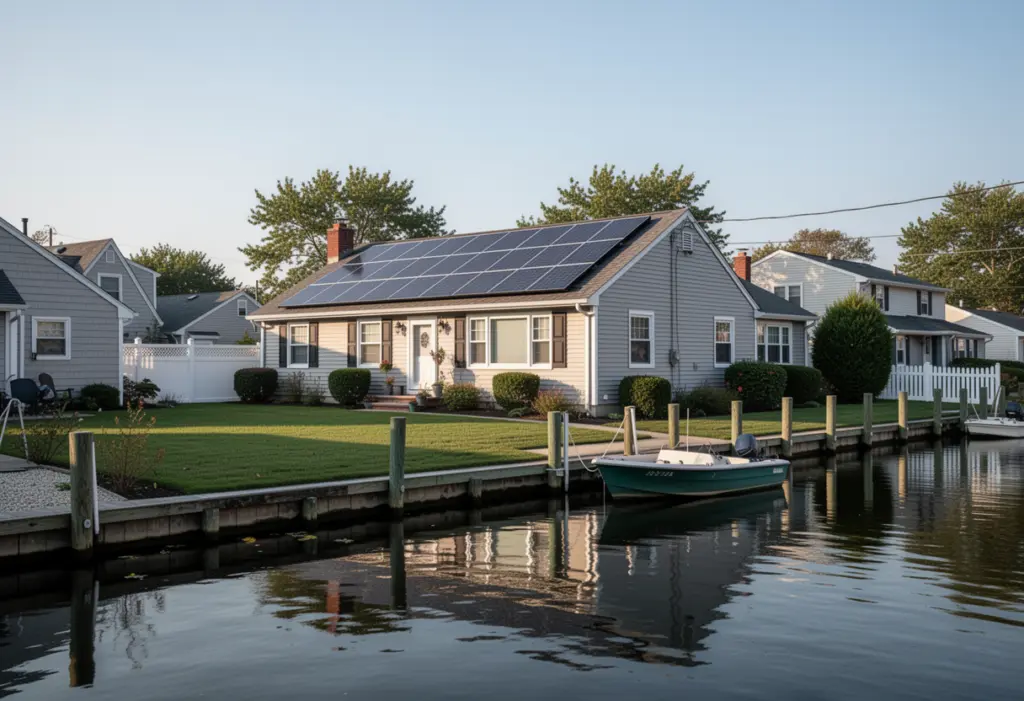
Massapequa sits on the South Shore of Nassau County in the Town of Oyster Bay, with ZIP codes 11758 and 11762. Two things about the place decide a solar project here before anyone talks about equipment: which municipality issues the permit, and how close the property is to the water.
Town of Oyster Bay, or Village of Massapequa Park
Massapequa itself is unincorporated, so the Town of Oyster Bay issues the building permit. But Massapequa Park is a separate incorporated village with its own building department, its own fee schedule and its own turnaround, and the two share a postal identity closely enough that people mix them up routinely.
Establish which authority covers your parcel before an installer files anything. A permit lodged with the wrong department is time lost rather than a small correction, and it is the kind of error that is entirely avoidable with one check.
The canals, and where the equipment can sit
South of Merrick Road the neighbourhoods are cut by residential canals running to the Great South Bay, and a great deal of that ground is mapped flood plain. Where it applies it governs where the electrical equipment may be mounted, not whether you can have solar:
- The inverter, the AC and DC disconnects, the production meter and any battery usually have to sit above a specified elevation — a different wall, a different height, or an interior location rather than the default spot beside the meter.
- A battery in a basement or a low garage is frequently the wrong answer on these properties even where it is the cheapest place to put it.
- The design has to be right the first time, because relocating equipment after inspection is expensive.
Ask whether your parcel is in a mapped zone and what the town or village requires, before a design is drawn. An installer who works mostly inland may not raise it at all.
Salt air and wind
Waterfront and near-waterfront exposure argues for two questions that inland quotes skip. Ask what wind load the racking and attachments are specified for, not only the snow load. And ask about corrosion: hardware, fasteners and outdoor enclosure ratings all matter more within reach of salt air, and the cheapest item on the shelf is rarely the one specified for it.
Post-war housing: service and roof
Much of Massapequa is post-war tract housing, which raises the two checks that decide most South Shore quotes.
Service capacity. A 100 amp panel is the norm in this stock, and a solar breaker frequently will not fit one without an upgrade or a line-side tap. Have the rating checked and the busbar looked at before contract, and have whatever it costs written onto the quote. It is legitimate work, but it should not be a surprise sprung after the crew arrives.
Roof. Shingles with under about ten years left in them should be replaced first: lifting an array off and putting it back later is the expensive way to do the same work. Ranch and split-level roofs here are often simple and generous, which fits more modules than a cut-up older roofline, though fire-access pathways and setbacks still take proportionally more of a modest plane, so ask how much capacity went to clearances.
The utility, and what each extra kilowatt costs
Confirm the utility name printed on your own bill. Most of Nassau County is served by PSEG Long Island, which operates the LIPA system, but Freeport and Rockville Centre run their own municipal electric utilities further west along the same shore. A municipal utility is outside Public Service Commission jurisdiction, so its customers have no state net metering, no Customer Benefit Contribution and no standardised state interconnection process, and must ask the utility for its own terms.
For a PSEG Long Island customer the Customer Benefit Contribution is easiest to think about as a price per kilowatt of DC capacity: $1.13 per kW-month in 2026, owed by anyone who interconnected on or after 1 January 2022, whatever the array produces. Every extra kilowatt on the design therefore adds $1.13 a month, so moving from an 8 kW system at $9.04 a month to an 11 kW system at $12.43 costs $3.39 a month more, about $41 a year. The rate is re-set annually rather than fixed at interconnection. Phase One net metering credits exported kilowatt-hours at the full retail rate and holds for 20 years from interconnection.
2026 incentives
There is no 30% federal credit on a 2026 purchase. Section 25D was terminated for expenditures made after 31 December 2025, an expenditure being treated as made when the original installation is completed. Any proposal still showing that line is materially wrong.
What survives federally is the business-side credit, and it is claimed by the company that owns a leased or power-purchase system rather than by you. That is why third-party offers can still price in a tax benefit the householder never sees, and it is worth understanding before comparing a lease against a purchase on this shore, where such offers circulate heavily.
New York’s own credit does reach those arrangements, on strict terms:
- It reaches a lease of at least ten years and a power purchase agreement of at least ten years, as well as an outright purchase. A five or seven year lease qualifies for nothing, however it is marketed.
- The $5,000 is a lifetime ceiling per agreement, not an annual figure — amounts claimed for that agreement in earlier years come off it.
- On an agreement running more than 15 years, no credit is allowed after the fifteenth year, even if the $5,000 has not been used up.
- For a lease the annual credit is the payments you made that year, capped by 25% of the total contracted payments or $5,000, whichever is less. A flat “25%” describes the PPA mechanic, not the lease one.
The rest of the stack is the state sales tax exemption and RPTL 487’s 15-year exemption where the Town of Oyster Bay or the Village of Massapequa Park, Nassau County and your school district have each not opted out, the district being the largest share of the bill. Confirm the live position of each with NYSERDA and the NY Department of Taxation and Finance before you sign. NY-Sun, including its income-qualified Affordable Solar incentive, is not part of it: on Long Island the last residential block closed on 17 April 2016, and as of September 2026 NYSERDA has no open NY-Sun block for homes in any utility territory; check NYSERDA’s NY-Sun dashboard for a new one.
Frequently Asked Questions
Who issues a solar permit in Massapequa?
The Town of Oyster Bay for unincorporated Massapequa, but Massapequa Park is a separate incorporated village with its own building department, fee schedule and turnaround. Establish which covers your parcel before anything is filed.
Does the flood plain stop me installing solar near the canals?
No, but it governs where the equipment can go. The inverter, disconnects, meter and any battery usually have to sit above a specified elevation, so a basement or low-garage battery is often the wrong answer even where it is cheapest.
Does the New York credit work on a solar lease or PPA?
Only on an agreement of at least ten years. The $5,000 is a lifetime ceiling for that agreement rather than an annual figure, no credit is allowed after the fifteenth year of a longer agreement, and the lease calculation is not the flat 25% used for a PPA.
What does PSEG Long Island charge a Massapequa solar customer?
$1.13 per kW-month of DC capacity in 2026, so every extra kilowatt adds $1.13 a month. An 8 kW system costs $9.04 a month and an 11 kW system $12.43, billed on capacity regardless of what the array produces.
This article is general information, not tax, legal or financial advice. Incentive amounts, eligibility rules and deadlines change and depend on your utility, your tax situation and your property. Confirm current terms with NYSERDA, your utility and a qualified tax professional before making a decision.
NY Solar Incentives
Independent New York solar research. We summarise NYSERDA, NY-Sun and federal programme rules from published sources and state plainly when a figure is an estimate. We are not a government agency and do not sell equipment.
Run the arithmetic on your own system
Check the dated program table and your arrangement before counting an incentive. Standard residential NY-Sun blocks are closed; Long Island Affordable Solar has a conditional income-verification route. The NY credit depends on qualified costs and tax liability, while the NYC abatement reduces future property-tax bills. The estimator keeps those timings separate.