Solar Incentives in Valley Stream, NY
A Valley Stream mailing address does not prove you are inside the village, and Valley Stream homeowners can carry more than one school levy. Both decide what the incentives are worth.
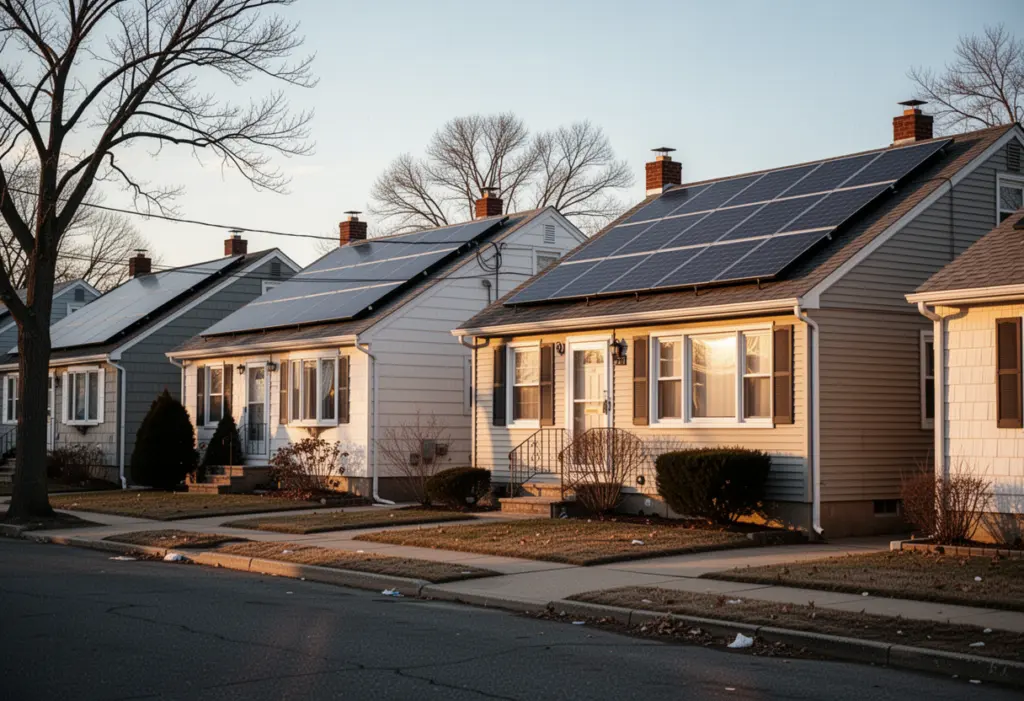
Valley Stream is an incorporated village in the Town of Hempstead, Nassau County, with ZIP codes 11580, 11581 and 11582. Two local facts decide what the 2026 incentives are actually worth here, and neither appears in a general New York solar guide.
A Valley Stream address is not proof of a Valley Stream village address
The Valley Stream postal area extends beyond the village boundary into unincorporated parts of the Town of Hempstead. That is not a technicality:
- Inside the village, the Village of Valley Stream issues the building permit.
- Outside it, the Town of Hempstead does, with a different fee schedule and a different turnaround.
- For RPTL 487, the 15-year property tax exemption on the added value of the system, the village opt-out only matters if you are actually in the village.
Check your parcel rather than your mailbox, and do it before an installer files anything. A permit lodged with the wrong authority is time lost, not a small correction.
More than one school levy to check
School taxes are the largest single share of a Nassau County tax bill, which makes the school district the first RPTL 487 opt-out to check rather than the last. Valley Stream complicates it: the area is served by separate elementary school districts and a central high school district covering them, so a parcel here can carry two school levies rather than one.
A school district opts out of section 487 by resolution, independently of the village, the town and the county. So the full check for a Valley Stream homeowner is:
- The village, if your parcel is inside it.
- The Town of Hempstead.
- Nassau County.
- Each school district that appears on your tax bill.
Section 487 also requires the system to be constructed before 1 January 2030. Ask the assessing authority in writing rather than relying on an installer’s summary.
The house
Much of Valley Stream is post-war housing on modest lots. Ask early what your electrical service is rated at and whether the busbar has room for a solar breaker, because 100 amp service is common in this stock and the panel upgrade or line-side tap that follows belongs in the quote you sign rather than in a conversation afterwards. On a small roof, fire-access pathways and setbacks also swallow a bigger proportion of the usable plane than they would on a large one, so ask how much capacity went to clearances before concluding a design is undersized. On shingles, anything under roughly ten years of remaining life argues for re-roofing before the array goes on.
Who bills you, and what the charge comes to
Read the utility name off your own bill before accepting any figure. The South Shore does not sit under a single company: most of Nassau County is PSEG Long Island, which operates the LIPA system, while Freeport and Rockville Centre run their own municipal electric utilities a short distance west. Municipal customers are outside Public Service Commission jurisdiction altogether — no state net metering, no Customer Benefit Contribution, no standardised interconnection process, and terms that have to be requested from the utility itself.
For a PSEG Long Island customer the Customer Benefit Contribution is a monthly charge on the DC size of the array, owed by anyone who interconnected on or after 1 January 2022 and levied on capacity whatever the weather does. At the 2026 residential rate of $1.13 per kW-month a 6 kW system pays $6.78 a month, about $81 a year, and a 9 kW system $10.17, about $122. The rate is re-set annually. Phase One net metering runs the other way, crediting exports at the full retail rate for 20 years from interconnection, and community solar subscribers pay no Customer Benefit Contribution at all.
The incentives that remain in 2026
The 30% federal residential credit has been terminated. Section 25D shut to expenditures made after 31 December 2025, and the date that counts is the day the original installation is completed. Read every 2026 quote for that line first, because a proposal carrying it is wrong before you reach the rest of the arithmetic.
Of what is left, the item that turns on something specific to Valley Stream is RPTL 487. Because school taxes dominate a Nassau bill and a parcel here can carry two of them, the exemption is worth most, and is most easily lost, at the school district level — so get a written answer from every district on your bill before treating it as yours. The rest of the stack is the state’s 25% credit capped at $5,000 on Form IT-255 at a principal residence, limited to your actual state tax liability with a five-year carry-forward and reaching leases and power purchase agreements of ten years or more; and the state sales tax exemption. None of these is permanent. Confirm each with NYSERDA and the NY Department of Taxation and Finance on the day you sign. NY-Sun and its income-qualified Affordable Solar incentive, which your contractor used to apply, are not part of the stack: as of September 2026 NYSERDA has no open NY-Sun block for homes in any utility territory; check NYSERDA’s NY-Sun dashboard for a new one.
Frequently Asked Questions
Am I in the Village of Valley Stream or the Town of Hempstead?
Check the parcel, not the mailing address — the Valley Stream postal area extends beyond the village boundary. Inside the village the village issues the permit; outside it the Town of Hempstead does, with a different fee schedule and turnaround.
How many school districts do I check for the property tax exemption?
Every district that appears on your tax bill. The area is served by separate elementary districts and a central high school district covering them, so a parcel can carry two school levies, and each district opts out of RPTL 487 by its own resolution.
Which incentives still apply in 2026?
New York's 25% credit capped at $5,000 on Form IT-255, the state sales tax exemption, and RPTL 487 where nobody has opted out. The 30% federal residential credit has ended, and NY-Sun, including its Affordable Solar incentive, has no open block for homes as of September 2026.
What does PSEG Long Island charge a Valley Stream solar customer?
The Customer Benefit Contribution at $1.13 per kW-month of DC system size for 2026 — about $81 a year on a 6 kW system and $122 on 9 kW, levied on capacity whatever the weather does.
This article is general information, not tax, legal or financial advice. Incentive amounts, eligibility rules and deadlines change and depend on your utility, your tax situation and your property. Confirm current terms with NYSERDA, your utility and a qualified tax professional before making a decision.
NY Solar Incentives
Independent New York solar research. We summarise NYSERDA, NY-Sun and federal programme rules from published sources and state plainly when a figure is an estimate. We are not a government agency and do not sell equipment.
Run the arithmetic on your own system
Check the dated program table and your arrangement before counting an incentive. Standard residential NY-Sun blocks are closed; Long Island Affordable Solar has a conditional income-verification route. The NY credit depends on qualified costs and tax liability, while the NYC abatement reduces future property-tax bills. The estimator keeps those timings separate.