Solar Panel Cost in Garden City, NY
Garden City has large houses under a heavy street canopy, and its own village building department. Each of those three facts moves the number on the quote.
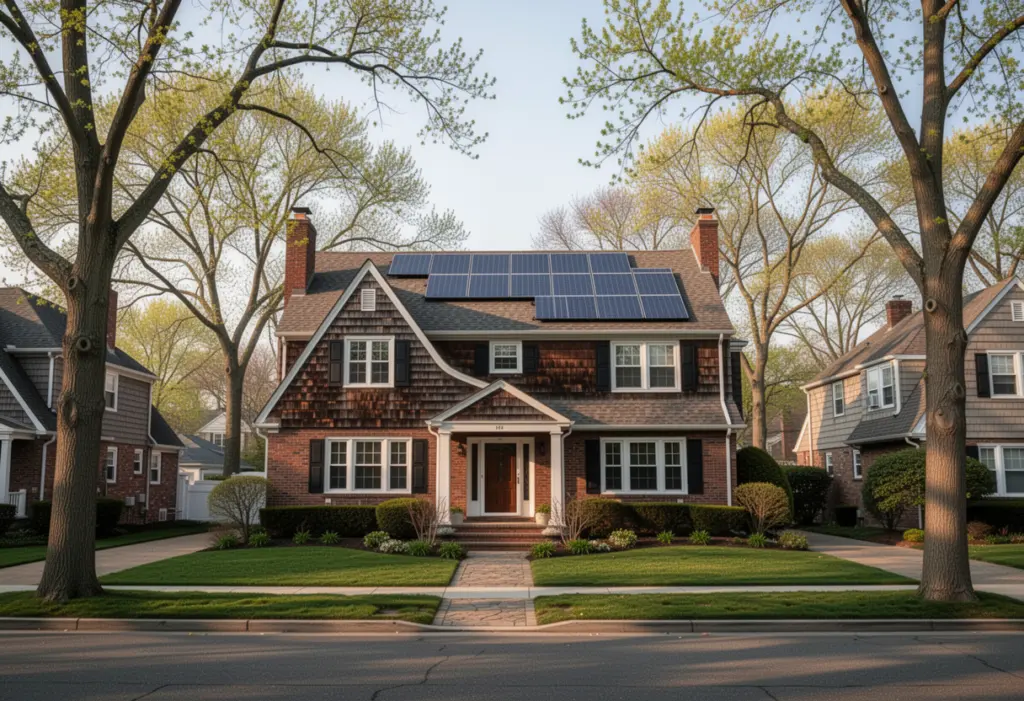
Garden City is an incorporated village in the Town of Hempstead, Nassau County, ZIP code 11530. It is a planned village of large houses on broad, heavily planted streets, and every one of those characteristics shows up in a solar quote. Here is what actually drives the number.
The village is the permitting authority, not the town
Garden City is incorporated, so the Village of Garden City runs its own building department. The Town of Hempstead surrounds it but does not permit inside it. Ask an installer directly whether they have filed in this village before, and ask the village whether any architectural or design review applies ahead of the building permit — that is a separate municipal step with its own meeting calendar, and a board that meets monthly turns a missed submission deadline into four weeks.
Where review does apply, design for approval instead of arguing after refusal: a rear or secondary roof plane away from the public way, all-black modules with black frames rather than silver, flush mounting that follows the roof plane, and conduit run internally or painted where it is exposed.
Large houses, and the cap that binds
Consumption here runs high, so arrays run large, and size cuts in two directions. The monthly charge rises with every kilowatt. The Customer Benefit Contribution applies to any system interconnected on or after 1 January 2022 and is set against DC capacity rather than output, at a 2026 PSEG Long Island residential rate of $1.13 per kW-month:
- A 12 kW array: $13.56 a month, about $163 a year.
- A 16 kW array: $18.08 a month, about $217 a year.
The state credit does not rise with the array. New York’s 25% credit stops at $5,000 whatever the system costs, so qualified expenditure beyond roughly $20,000 earns nothing further, and on a Garden City-sized system that ceiling arrives well before the design is finished. A proposal printing a flat 25% against the whole contract price is describing a credit you will not receive. Two conditions sit on it besides: the equipment has to serve your principal residence, and the credit cannot exceed your actual New York State tax liability for the year, though the balance carries forward for up to five years.
The canopy is a real cost driver
Garden City’s street trees are one of the reasons people live here, and they are also the most common reason a system ends up smaller, or produces less, than an aerial estimate promised. What settles it is the December sun angle, because December is when the credit bank is being drawn down rather than filled.
Three things to insist on. First, a shading assessment carried out at the house rather than from satellite imagery — where two installers’ production figures diverge sharply, the usual explanation is that one of them never came. Second, the December and January rows of the model, not the annual total at the bottom of it. Third, any tree removal treated as your decision and priced separately, rather than an assumption folded quietly into a production estimate: it is permanent, and on these streets the trees are part of what the property is worth.
Roof and service
Older Garden City housing includes slate and standing-seam metal. Slate needs a mounting approach not every installer is equipped for, so ask what they have done on your roof type and ask for photographs. Standing seam is the best case, because racking clamps to the seams with no penetrations at all. On asphalt the arithmetic is simpler: under about ten years of shingle life left means re-roof first, because an array removed and refitted later costs far more than one mounted once on a new roof.
Ask for the service rating and whether the busbar can take a solar breaker. Where an upgrade or a line-side tap is needed it is a real cost rather than padding, but it belongs on the written quote, priced, before you sign anything.
Taxes, and the utility on your bill
RPTL 487 keeps the added value of the system out of your assessment for 15 years wherever the taxing body has not opted out, and there are four bodies to ask: the Village of Garden City, the Town of Hempstead, Nassau County and your school district. School taxes are the largest share of a Nassau bill, so the district is the one to check first. The exemption also reaches only systems constructed before 1 January 2030.
Check the utility name on the bill itself. Most of Nassau is PSEG Long Island, operator of the LIPA system, but Freeport and Rockville Centre run municipal electric utilities outside Public Service Commission jurisdiction, where state net metering and the Customer Benefit Contribution do not apply and terms come from the utility instead.
2026 incentives
The federal 30% residential credit has ended. Section 25D no longer reaches expenditures made after 31 December 2025, and for this purpose an expenditure dates from completion of the original installation. On a large system that is the biggest single number to come off a 2026 quote, and a proposal still showing it is wrong.
Which leaves the ceiling as the thing to plan around here:
- The state credit is capped at $5,000 — 25% of qualified expenditure on Form IT-255, principal residence only, reaching leases and power purchase agreements of ten years or more as well as purchases. On a large array, treat it as a fixed sum rather than a percentage.
- NY-Sun used to scale with system size and region, but it pays nothing on a Garden City home now: on Long Island the last residential block closed on 17 April 2016, and as of September 2026 NYSERDA has no open NY-Sun block for homes in any utility territory; check NYSERDA’s NY-Sun dashboard for a new one. If a proposal still shows a NY-Sun reduction, ask which open block it relies on.
- The state sales tax exemption follows the size of the bill rather than stopping at a ceiling, with localities electing separately on their own share.
- RPTL 487, subject to the four opt-out checks above.
These programmes are amended by the bodies that run them, and NY-Sun in particular pays only while NYSERDA has a block open for homes. Take the current position from NYSERDA and the NY Department of Taxation and Finance on the day you sign.
Frequently Asked Questions
Does the village or the town issue a Garden City solar permit?
The Village of Garden City runs its own building department. The Town of Hempstead surrounds the village but does not permit inside it. Ask the village whether any architectural or design review applies ahead of the building permit, and when that board meets.
Is the state credit worth less on a large Garden City system?
Proportionally, yes. It is 25% of qualified expenditure but stops at $5,000, so beyond roughly $20,000 of qualified cost it adds nothing. On a large array treat it as a fixed sum rather than the flat percentage a proposal may print.
How much is the PSEG Long Island solar charge here?
The Customer Benefit Contribution at $1.13 per kW-month of DC system size for 2026 — about $163 a year on a 12 kW array and $217 on 16 kW. It is charged on capacity regardless of production and reset annually.
How do the street trees change the price?
They can reduce the system size or the production it is worth building, and the December sun angle is what makes an obstruction decisive, in the month credits are being drawn down. Insist on an assessment made at the house and ask for the December and January rows of the model.
This article is general information, not tax, legal or financial advice. Incentive amounts, eligibility rules and deadlines change and depend on your utility, your tax situation and your property. Confirm current terms with NYSERDA, your utility and a qualified tax professional before making a decision.
NY Solar Incentives
Independent New York solar research. We summarise NYSERDA, NY-Sun and federal programme rules from published sources and state plainly when a figure is an estimate. We are not a government agency and do not sell equipment.
Run the arithmetic on your own system
Check the dated program table and your arrangement before counting an incentive. Standard residential NY-Sun blocks are closed; Long Island Affordable Solar has a conditional income-verification route. The NY credit depends on qualified costs and tax liability, while the NYC abatement reduces future property-tax bills. The estimator keeps those timings separate.