Solar Panel Cost in Riverhead, NY
Riverhead has land, which changes the whole calculation. A ground mount is a real option here, and so is a trench nobody mentioned until the contract was signed.
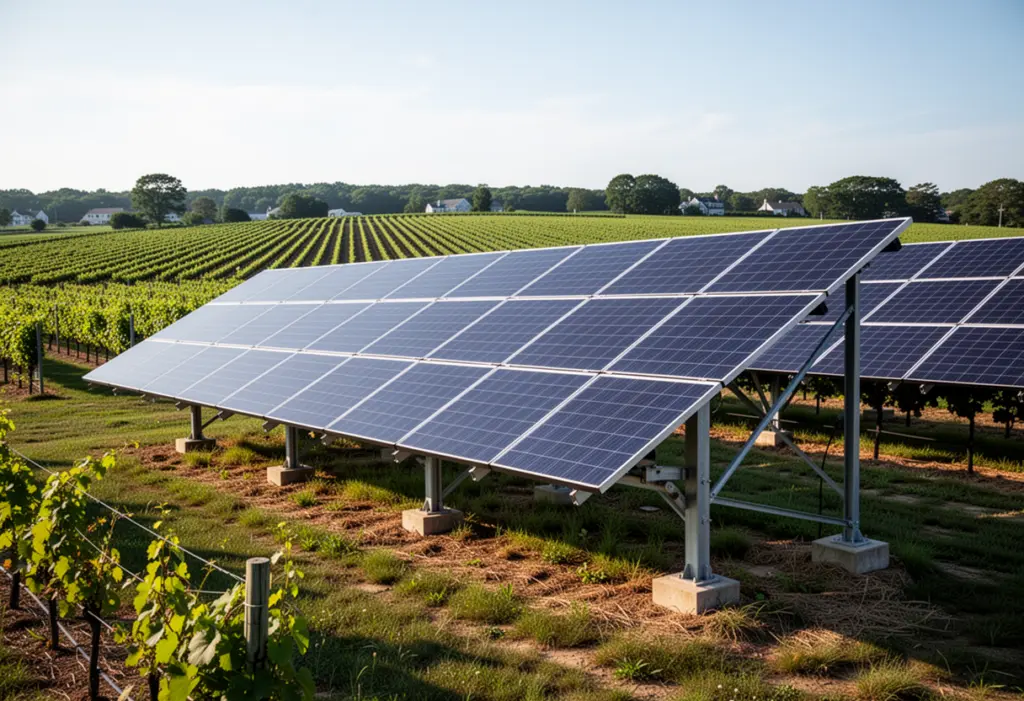
Riverhead is a town in Suffolk County at the head of the Peconic estuary, where the North and South Forks divide. ZIP codes include 11901, 11933, 11931, 11947 and 11792. It is the county seat and it is still substantially agricultural, and that combination changes the cost of a solar system in ways the rest of Long Island does not share.
One authority, which is unusual out here
Suffolk towns are large and each issues its own permits, and most of the East End towns are further divided by incorporated villages with their own building departments. Riverhead is not: the Town of Riverhead building department is the authority across the town. That is a genuine simplification compared with neighbouring Southold, which contains the Village of Greenport, or Southampton, which contains seven villages.
Confirm it for your own address anyway, and ask what the current turnaround is. A project waiting on a permit is a project not producing.
Land changes the arithmetic
Many Riverhead properties have room, so a ground mount is a genuine option rather than a fallback. What it buys you is real: orientation and tilt are chosen rather than inherited from the roof, the roof-age question disappears entirely, and cleaning and inspection happen at ground level.
What it costs is where quotes diverge, and the largest single item is frequently the one people do not ask about:
- The trench. The conductors have to run from the array back to the service, and on an agricultural parcel that can be a long way. Trenching, conduit, larger conductors to control voltage drop and restoration of the ground are all real money, and the cost scales with distance. Ask for the run length and for that item priced separately.
- Foundations below the frost line, and a soil condition that suits the chosen foundation type. Ask what the design assumes and whether it has been checked on site.
- Setbacks and site plan review, which can add a municipal step ahead of the building permit.
- Clearance beneath the lowest row. An array set too low is buried by drifted snow and splashed by mud.
If the land is in an agricultural district or under a farmland preservation arrangement, establish what is permitted before designing anything. That is a question for the town and the county, not for the installer.
What PSEG Long Island charges
Ground-mounted systems are bigger, so the standing utility charge that follows them is bigger too. The Customer Benefit Contribution attaches to everything interconnected from 1 January 2022 onward and is worked out from DC capacity, at $1.13 a kilowatt a month on PSEG Long Island for 2026:
- A 13 kW system: $14.69 a month, about $176 a year.
- A 17 kW system: $19.21 a month, about $231 a year.
It is charged on capacity regardless of production and recalculated annually, so a larger array carries that cost every month whether or not the extra capacity is being used. Size the system to your consumption rather than to the space available. Exports are credited at the full retail rate under Phase One net metering, which holds for 20 years from interconnection.
One local check before you accept any of that: the Village of Greenport, immediately east of here in the Town of Southold, and Fishers Island run their own municipal electric utilities. A municipal customer sits outside Public Service Commission jurisdiction, so state net metering, this charge and the standardised interconnection process do not apply, and the terms have to be asked for directly. Riverhead itself is PSEG Long Island territory, but the utility name printed on your own bill is what settles it.
Coastal exposure on two sides
Riverhead touches Long Island Sound at Wading River and Flanders Bay to the south, and the open agricultural country in between carries real wind exposure of its own. Ask what wind load the racking and attachments are specified for, on a ground mount as much as on a roof — a ground array is a large sail on an exposed field.
Near the water, ask what the fasteners and clamps are made of and what enclosure rating the inverter and outdoor disconnects carry, because salt shortens the life of ordinary hardware. And on low-lying property along the Peconic River, a mapped flood zone can decide where the equipment may be mounted, usually above a specified elevation.
Houses here are not all the same age
Older farmhouses draw structural letters more often and frequently have 100 amp service, where fitting a solar breaker can require an upgrade or a line-side tap. Newer subdivision housing usually clears both but may carry covenants or an association rule, which is a private agreement separate from the town permit. The roof gate applies to both: under roughly ten years of shingle life left means re-roof first.
2026: the incentives that follow the equipment bill
The 30% federal residential credit is gone. Section 25D no longer reaches expenditures made after 31 December 2025, and an expenditure is dated to the completion of the original installation. One carve-out is worth knowing where a house is itself newly built: for work done as part of constructing or reconstructing a structure, the expenditure instead counts as made when your own use of that structure begins, so panels fitted in December 2025 to a house first occupied in 2026 do not qualify either.
On a large ground mount, two programmes behave differently from the way homeowners expect, and both track the equipment bill rather than the tax return — though only the first is still open to homes.
The first is the state sales tax exemption. New York exempts residential solar energy system equipment from state sales tax, and localities may separately elect to exempt their local share, so the total relief differs by county and city. Because a ground mount carries a heavy equipment component — modules, racking, foundations, conductors — the exemption is a larger absolute number here than on a modest roof array. Suffolk County is one of the counties that exempt their local share too (Publication 718-S), so no sales tax should be added to the equipment or its installation. A quote is normally priced before tax, so the exemption shows up as no tax added rather than as a deduction from the quoted price; ask the installer to confirm the quote carries no sales tax.
The second is NY-Sun, which used to arrive as a reduction on the contractor’s price rather than as anything you file. It was set by system size and region and structured in megawatt blocks, with the per-watt figure stepping down as each regional block filled — deliberately, since the programme was designed to phase out as the market matured. On Long Island the last residential NY-Sun block closed on 17 April 2016, and Affordable Solar, the income-qualified version, has no open block for homes either. As of September 2026 NYSERDA has no open NY-Sun block for homes in any utility territory; check NYSERDA’s NY-Sun dashboard for a new one. If a quote still assumes a per-watt NY-Sun figure, ask which open block it is based on.
Also still there: New York’s 25% credit capped at $5,000 on Form IT-255, which on the larger systems a ground mount makes possible is bound by the cap rather than the rate — it requires your principal residence in New York, is limited by your actual state tax liability, carries forward up to five years, and reaches leases and power purchase agreements of ten years or more. And RPTL 487‘s 15-year property tax exemption, where the Town of Riverhead, Suffolk County and your school district have each not opted out, with construction before 1 January 2030. Confirm the current position with NYSERDA and the New York State Department of Taxation and Finance, and check the exemption with your assessor, before you sign anything.
Frequently Asked Questions
Is a ground mount worth it in Riverhead?
Often. Orientation and tilt can be chosen, the roof-age question disappears, and maintenance happens at ground level. The cost that decides it is usually the trench from the array back to the service, which scales with distance and belongs in the quote as a separate line.
Who issues my solar permit in Riverhead?
The Town of Riverhead building department covers the town, which is simpler than neighbouring Southold or Southampton where incorporated villages run their own. Confirm it for your address and ask what the current turnaround is.
Does a bigger array always pay in Riverhead?
Not automatically. The Customer Benefit Contribution is charged on DC capacity regardless of production, at $1.13 per kW-month for 2026 — about $176 a year on 13 kW and $231 on 17 kW. Unused capacity costs you every month, so size to consumption rather than to the land available.
Is my Riverhead property definitely on PSEG Long Island?
Almost certainly, but read your bill. Just east of here the Village of Greenport and Fishers Island run their own municipal electric utilities, and those customers sit outside state net metering, the Customer Benefit Contribution and the standardised interconnection process.
This article is general information, not tax, legal or financial advice. Incentive amounts, eligibility rules and deadlines change and depend on your utility, your tax situation and your property. Confirm current terms with NYSERDA, your utility and a qualified tax professional before making a decision.
NY Solar Incentives
Independent New York solar research. We summarise NYSERDA, NY-Sun and federal programme rules from published sources and state plainly when a figure is an estimate. We are not a government agency and do not sell equipment.
Run the arithmetic on your own system
Check the dated program table and your arrangement before counting an incentive. Standard residential NY-Sun blocks are closed; Long Island Affordable Solar has a conditional income-verification route. The NY credit depends on qualified costs and tax liability, while the NYC abatement reduces future property-tax bills. The estimator keeps those timings separate.