Solar Panel Cost in Islip, NY
Islip runs from dense post-war neighbourhoods to two barrier island villages with no roads. The cost of a system varies more within this town than between most others.
On this page 8 sections
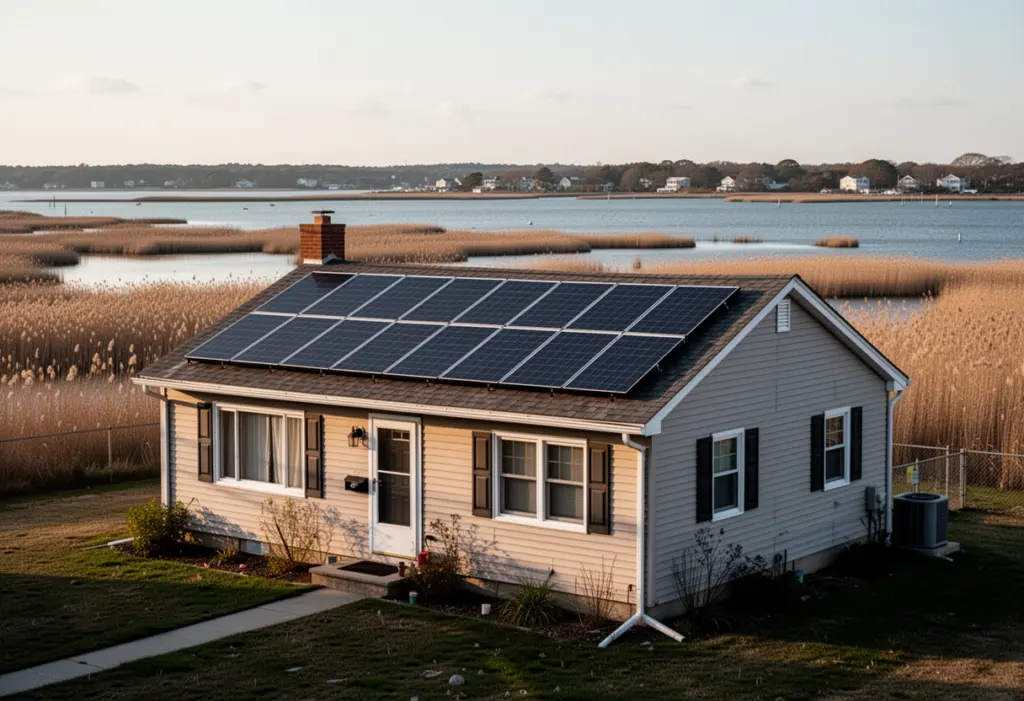
Islip is a town in Suffolk County on the south shore, stretching from Brentwood and Central Islip down to the Great South Bay and out onto Fire Island. ZIP codes include 11751, 11706, 11717, 11722, 11730, 11795, 11716, 11779, 11782 and 11769. Very little about the cost of a system here is uniform, because the town is not.
The flood plain decides where the equipment goes
Low-lying property along the Great South Bay and the creeks feeding it sits in mapped flood plain, and where that applies it governs where the electrical equipment may be mounted — the inverter, the AC and DC disconnects, the production meter and any battery.
The practical consequences:
- Equipment usually has to sit above a specified elevation, which can mean a different wall, a greater height, or an interior location rather than the default position beside the meter.
- A battery in a basement or a low garage is frequently the wrong answer on these properties even where it is the cheapest place to put it.
- The design has to be right the first time. Moving equipment after inspection is expensive.
Ask directly whether your address is in a mapped zone and what the town requires, before a design is drawn. An installer who works mainly inland may not raise it at all.
Fire Island is a different project entirely
Two of Islip’s incorporated villages, Ocean Beach and Saltaire, are on Fire Island, and each has its own building department. So do the mainland villages of Brightwaters and Islandia. Suffolk towns are large and each issues its own permits, so establish which authority covers your address before an installer files anything.
On the barrier island two things change the arithmetic and neither appears on a standard quote:
- Everything travels by ferry or barge, and there is no vehicle access in the village communities. Modules, racking, inverters, crew time and inspection visits all carry that overhead. Ask for it to be itemised rather than absorbed.
- Most houses there are seasonal or second homes, and a seasonal or second home does not qualify for New York’s IT-255 credit at all. The credit requires your principal residence in New York. If the house is not that, the single largest remaining incentive is zero and the whole case has to be made without it.
What PSEG Long Island charges
One recurring cost has nothing to do with how much the array produces. Systems interconnected since 1 January 2022 pay a Customer Benefit Contribution every month, calculated per kilowatt of DC capacity, and PSEG Long Island’s residential figure for 2026 is $1.13. On the modest arrays a compact south-shore roof supports, that comes to:
- A 5 kW system: $5.65 a month, about $68 a year.
- A 9 kW system: $10.17 a month, about $122 a year.
Billed on capacity regardless of production and recalculated annually, so the figure in your proposal is this year’s figure and not a fixed one. What you export is credited at the full retail rate under Phase One net metering, and that arrangement holds for 20 years from interconnection.
Take the utility name from your own bill rather than from your address. The two exceptions recorded in Suffolk are the Village of Greenport and Fishers Island, both far to the east, whose municipal electric customers sit outside Public Service Commission jurisdiction — no state net metering, no contribution, and no standardised interconnection process.
Small roofs set the size, not your consumption
Bay Shore, Brentwood and Central Islip carry dense post-war housing on compact lots. Three things follow:
- Fire-access clearances take proportionally more of a small roof. Code requires pathways and setbacks around the array, and on a modest plane those consume a larger share of what is available.
- 100 amp service is common, and fitting a solar breaker can require a panel upgrade or a line-side tap. This is the most frequent cost surprise here. Ask what your service is and whether the busbar has room, and get it in the quote rather than as a change order.
- Obstructions cost more. A dormer or vent that would be worked around on a large roof removes a meaningful fraction of a small one.
Ask what is limiting your system size. If the answer is roof area rather than consumption, that is worth knowing before you judge the quote.
Salt and wind
The south shore is exposed. Ask what wind load the racking and attachments are specified for, not only what snow load — coastal exposure raises the wind figure above the inland one. Ask what the fasteners and clamps are made of, since salt shortens the life of ordinary hardware, and what enclosure rating the inverter and outdoor disconnects carry.
Renting, and the meter question
Islip has a substantial rented and two-family housing stock, and there the meter decides everything: a system offsets only the meter it is connected behind. A landlord-side array offsets the landlord’s usage, not a tenant’s apartment, even where the panels sit directly above it. For tenants, community solar reaches the person actually paying the bill — no roof, no up-front cost, and subscribers pay no Customer Benefit Contribution at all.
2026: the adder that is not there
There is no federal credit left to claim. Section 25D ended for expenditures made after 31 December 2025, with an expenditure treated as made at the completion of the original installation. Where a quote still carries a 30% federal line, the payback figure underneath it is wrong by roughly that amount.
Losing it hurts most where the budget was tightest, which is why people here ask about Affordable Solar, the NYSERDA adder that increased the NY-Sun incentive for lower-income households. On Long Island it is not there to ask for: PSEG Long Island’s last residential NY-Sun block closed on 17 April 2016, and NYSERDA’s Long Island block chart lists no Affordable Solar block for homes. As of September 2026 NYSERDA has no open NY-Sun block for homes in any utility territory; check NYSERDA’s NY-Sun dashboard for a new one.
In Brentwood, Central Islip and Bay Shore, as anywhere else on Long Island, a quote that shows an NY-Sun or Affordable Solar reduction anyway should name the open NYSERDA block it comes from; ask to see it as a line on the quote. There is no penalty for asking and no version of this where staying quiet helps you.
The rest of the 2026 package, for a principal residence in New York: the state’s 25% credit capped at $5,000 on Form IT-255, limited by your actual state tax liability, carrying forward up to five years, and reaching leases and power purchase agreements of ten years or more as well as purchases; the state sales tax exemption; and RPTL 487‘s 15-year property tax exemption where the town or your village, Suffolk County and your school district have each not opted out, with construction before 1 January 2030. Programmes are revised, so check the position with NYSERDA and the New York State Department of Taxation and Finance, and check the exemption with your assessor, before you sign anything.
Frequently Asked Questions
Does the flood plain affect a solar installation in Islip?
On low-lying property near the Great South Bay, yes. The inverter, disconnects, meter and any battery usually have to sit above a specified elevation, so a basement or low garage battery is frequently the wrong answer even where it is cheapest.
Can I claim the state credit on a Fire Island house?
Only if it is your principal residence in New York. Most Fire Island houses are seasonal or second homes, and those do not qualify for the IT-255 credit at all, so the case has to be made without it.
Why is my Islip system smaller than I expected?
Usually roof area rather than consumption. Post-war houses on compact lots give less usable plane, fire-access clearances take proportionally more of a small roof, and a dormer or vent removes a bigger fraction than it would on a large one.
What does PSEG Long Island charge an Islip solar customer?
The Customer Benefit Contribution at $1.13 per kW-month of DC system size for 2026 — about $68 a year on a 5 kW system and $122 on 9 kW. Community solar subscribers pay none of it.
This article is general information, not tax, legal or financial advice. Incentive amounts, eligibility rules and deadlines change and depend on your utility, your tax situation and your property. Confirm current terms with NYSERDA, your utility and a qualified tax professional before making a decision.
NY Solar Incentives
Independent New York solar research. We summarise NYSERDA, NY-Sun and federal programme rules from published sources and state plainly when a figure is an estimate. We are not a government agency and do not sell equipment.
Run the arithmetic on your own system
Check the dated program table and your arrangement before counting an incentive. Standard residential NY-Sun blocks are closed; Long Island Affordable Solar has a conditional income-verification route. The NY credit depends on qualified costs and tax liability, while the NYC abatement reduces future property-tax bills. The estimator keeps those timings separate.