Solar Panel Cost in Huntington, NY
Huntington contains four incorporated villages that issue their own permits, and a shoreline that changes the hardware specification. Both show up in the price.
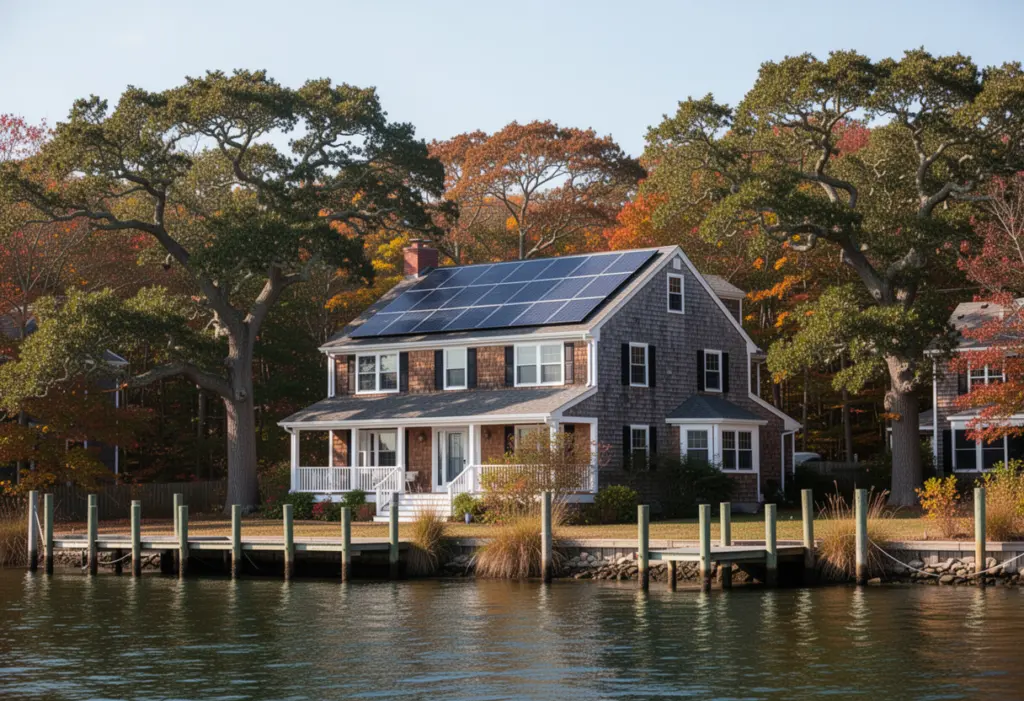
Huntington is a town in Suffolk County on the north shore of Long Island. ZIP codes include 11743, 11746, 11740, 11721, 11724, 11768 and 11731. What solar costs here is decided less by the modules than by four local conditions: which authority issues the permit, how exposed the property is to salt and wind, how wooded the lot is, and how large the house is.
Which authority issues the permit
Suffolk towns are large and each issues its own permits, and Huntington contains four incorporated villages that do their own. The Town of Huntington covers most addresses, but the Village of Northport, the Village of Lloyd Harbor, the Village of Huntington Bay and the Village of Asharoken each have their own building department.
Establish which covers your address before an installer files anything. A permit lodged with the wrong department is time lost rather than a small correction, and fee schedules and turnarounds differ between them.
Northport village and the older streets around the harbour carry real historic character, and architectural review can apply ahead of the building permit — a step capable of restricting street-visible placement. Where it does, design for approval rather than arguing after refusal:
- A rear or secondary roof plane. Anything the street cannot see is the easiest approval to obtain, and it settles most applications by itself.
- All-black modules with black frames. Silver frames read as industrial equipment.
- Flush mounting following the roof plane, rather than tilted racking.
- Concealed conduit, run internally or painted where it is exposed.
Ask when the board meets. Monthly meetings mean a missed submission deadline costs four weeks, and a project sitting in review is a project not producing.
Confirm the utility from your own bill
In Huntington the answer is almost certainly PSEG Long Island — but read the name printed on your own bill rather than inferring it from the address. Suffolk has two recorded exceptions, both far out on the North Fork: the Village of Greenport and Fishers Island run their own municipal electric utilities, and a municipal customer sits outside Public Service Commission jurisdiction altogether, with no state net metering, no Customer Benefit Contribution and no standardised interconnection process. Those terms are set by the utility and have to be asked for directly.
What PSEG Long Island charges
The Customer Benefit Contribution is a monthly charge on the DC size of the system, applied to anyone interconnecting on or after 1 January 2022. The 2026 residential rate on PSEG Long Island is $1.13 per kW-month:
- An 8 kW system: $9.04 a month, about $108 a year.
- A 12 kW system: $13.56 a month, about $163 a year.
It is billed on capacity regardless of production and recalculated annually, so it is not fixed at the rate printed in your proposal. Exports run under Phase One net metering, credited at the full retail rate, with that structure held for 20 years from interconnection.
Coastal exposure is a hardware specification
Huntington Harbor, Northport Harbor and Cold Spring Harbor put a great many properties within reach of salt air, and the shoreline villages more so. Three things follow, and each is a legitimate line item rather than padding:
- Wind load, not only snow load. Ask what wind speed the racking and attachments are specified for. Coastal exposure raises it above the inland figure.
- Salt-rated hardware. Fasteners, clamps and flashing corrode faster near the water. Ask what the fixings are made of.
- Enclosure ratings. The inverter and disconnects live outdoors. Ask what rating is specified and whether it suits a shoreline location.
On low-lying property near the harbours, mapped flood zones can also decide where the equipment may be mounted — inverter, disconnects, production meter and any battery frequently have to sit above a specified elevation. That makes a basement battery the wrong answer on some of these properties even where it is the cheapest place to put it. Ask whether your address is in a mapped zone before a design is drawn.
Trees, and the low December sun
The north shore carries heavy mature canopy and the terrain rolls. An obstruction that is irrelevant in July removes hours of production in December, which is the month the net metering credit bank is being drawn down. Insist on an on-site shading assessment rather than a satellite estimate, and ask what the model says about December and January specifically rather than only the annual total.
If tree removal is proposed, treat it as your decision rather than an assumption folded into a production estimate. It has real cost and it permanently changes a property where the trees are frequently part of the value.
Housing age
Huntington Station and East Northport carry a great deal of post-war housing where 100 amp service is common, and fitting a solar breaker can require a panel upgrade or a line-side tap. Ask what your service is and whether the busbar has room, and get the answer in the quote rather than as a change order after contract. Older village housing draws structural letters more often. The usual roof gate applies throughout: under roughly ten years of shingle life left means re-roof first, because removing and reinstalling an array later costs considerably more than mounting on a bare roof.
2026: a percentage that stops being a percentage
The 30% federal residential credit is gone. Section 25D was terminated for expenditures made after 31 December 2025, and an expenditure is treated as made when the original installation is completed. Any 2026 proposal still showing a 30% federal line is materially wrong, and that is the first thing to check on a quote.
What replaces it in the arithmetic is New York’s credit — and on the houses this town is known for, the headline rate is misleading. It is 25% of qualified expenditure, capped at $5,000, on Form IT-255. The cap, not the rate, is what governs once qualified expenditure passes roughly $20,000, and on the larger houses around Lloyd Harbor, Cold Spring Harbor and Huntington Bay that threshold is crossed routinely. Past it, every additional dollar of system attracts no further state credit at all, so a proposal presenting 25% of the whole project as a state benefit is overstating it, and overstating it more the bigger the array.
Three further conditions attach. The property must be your principal residence in New York — a seasonal, second or rental property does not qualify. The credit is limited by your actual New York State tax liability, is not refundable, and carries forward up to five years. And it reaches leases and power purchase agreements of ten years or more as well as outright purchases, with the ten-year minimum applying to the lease exactly as it does to the PPA.
NY-Sun is no longer part of it: PSEG Long Island’s last residential NY-Sun block closed on 17 April 2016, NYSERDA’s Long Island block chart lists no Affordable Solar block for homes, and as of September 2026 NYSERDA has no open NY-Sun block for homes in any utility territory; check NYSERDA’s NY-Sun dashboard for a new one. Still available: the state sales tax exemption on residential solar equipment; and RPTL 487, a 15-year property tax exemption on the added value, available where the town or your village, Suffolk County and your school district have each not opted out. Check those three separately, note that section 487 requires construction before 1 January 2030, and confirm the whole position with NYSERDA and the New York State Department of Taxation and Finance before you sign anything.
Frequently Asked Questions
Who issues my solar permit in Huntington?
The Town of Huntington covers most addresses, but the Villages of Northport, Lloyd Harbor, Huntington Bay and Asharoken each have their own building department. Establish which covers your address before anything is filed.
Does living near the water change the equipment specification?
Yes. Ask what wind speed the racking and attachments are specified for, what the fixings are made of, and what enclosure rating the inverter and disconnects carry. On low-lying harbour property a mapped flood zone can also dictate the mounting height.
What does PSEG Long Island charge a Huntington solar customer?
The Customer Benefit Contribution at $1.13 per kW-month of DC system size for 2026 — about $108 a year on an 8 kW system and $163 on 12 kW. It is billed on capacity regardless of production and recalculated annually.
Is the New York credit worth less on a large Huntington house?
Proportionally, yes. It is 25% of qualified expenditure but capped at $5,000 regardless of system size, so on a large array the cap binds and the credit covers a smaller share than a proposal quoting 25% of the whole cost suggests.
This article is general information, not tax, legal or financial advice. Incentive amounts, eligibility rules and deadlines change and depend on your utility, your tax situation and your property. Confirm current terms with NYSERDA, your utility and a qualified tax professional before making a decision.
NY Solar Incentives
Independent New York solar research. We summarise NYSERDA, NY-Sun and federal programme rules from published sources and state plainly when a figure is an estimate. We are not a government agency and do not sell equipment.
Run the arithmetic on your own system
Check the dated program table and your arrangement before counting an incentive. Standard residential NY-Sun blocks are closed; Long Island Affordable Solar has a conditional income-verification route. The NY credit depends on qualified costs and tax liability, while the NYC abatement reduces future property-tax bills. The estimator keeps those timings separate.