Solar Panel Installation in Sidney, NY
Sidney sits where the Unadilla meets the Susquehanna, which gives it more mapped flood plain than anywhere else in the region and makes equipment siting the first design decision.
On this page 8 sections
- 01Two rivers means an unusual amount of mapped flood plain
- 02Village or town
- 03In the town, a ground mount is a real option
- 04Older village housing
- 05NYSEG and the Customer Benefit Contribution
- 06Delaware County, and the utility on your bill
- 072026 incentives, and four bodies that each decide alone
- 08Frequently Asked Questions
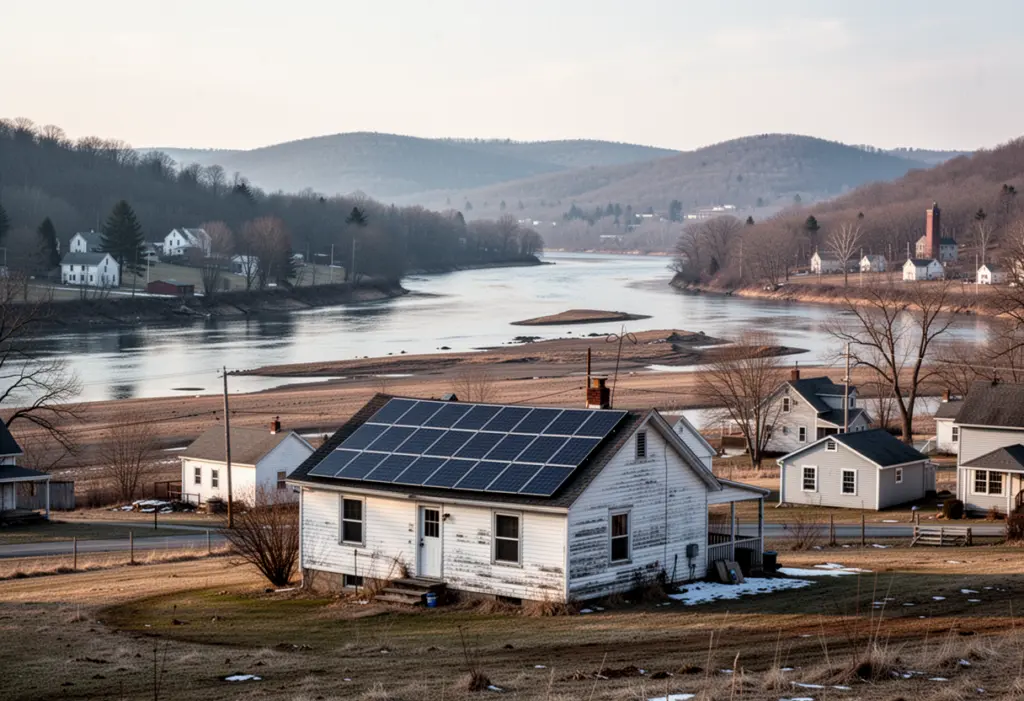
Sidney is an incorporated village inside the Town of Sidney, in Delaware County rather than Broome or Chenango, near the point where the Unadilla River joins the Susquehanna. ZIP code 13838. That confluence is the single most important thing about installing solar here.
Two rivers means an unusual amount of mapped flood plain
Sidney sits on flat river bottom land at the junction of two river systems, and a large share of the developed ground carries a mapped flood zone. What that dictates is the height at which anything electrical is permitted to sit: inverter, AC and DC disconnects, production meter and battery alike.
Three consequences, and the second is the one people get wrong:
- Equipment normally has to sit above a specified elevation, which can mean a different wall, a greater height, an interior location, or a longer conduit run than the default position beside the meter.
- A basement battery is frequently the wrong answer here, and in Sidney that is more often true than not, even though the basement is the least costly, tidiest and quietest place to put one.
- The design has to be right the first time. Relocating equipment after inspection is slow and expensive, and it can push a project across a programme year.
Ask directly whether your parcel is in a mapped zone and what elevation applies, before a design is drawn rather than after a proposal is signed. An installer travelling in from higher ground may not raise it at all.
Village or town
The Village of Sidney and the Town of Sidney are separate authorities with their own building departments, and the village sits inside the town. Establish which covers your address before an installer files anything, since fee schedules and turnarounds differ. Ask too whether the department works to the NYS Unified Solar Permit, which more than 300 authorities having jurisdiction in New York have adopted and which standardises the residential process for anything rated 25 kW DC or below.
In the town, a ground mount is a real option
Outside the village many properties have land, and a ground mount is a genuine choice rather than a fallback. Orientation and tilt are chosen rather than inherited, the roof-age question disappears entirely, and maintenance and snow clearing happen at ground level. In a valley where the southern horizon is set by wooded slopes, being able to place the array where the sky is open is worth a great deal.
Ask early about setbacks, site plan review, foundation depth below the frost line, and how much clearance sits beneath the lowest row, because an array set too low is buried by drifted snow for weeks. And on low ground the same flood plain rules that govern the inverter also bear on foundations and equipment pads.
Older village housing
The village stock is old, and it raises three questions before any equipment is chosen:
- How much life is left in the covering? Under roughly ten years on asphalt shingle and the sensible order is roof first, array second, because lifting and reinstating a finished system costs far more than fitting one to a bare deck.
- Will the structure need a letter? Older wood framing draws an engineer’s sign-off more often than modern construction does. Slate and standing-seam metal also turn up here, and standing seam is the happiest case of all, since the clamps grip the seams and nothing penetrates the roof.
- What is the supply rated at? 100 amp is common in housing of this age, and a solar breaker on it may need a panel upgrade or a line-side tap. Have that priced inside the quote.
NYSEG and the Customer Benefit Contribution
NYSEG’s Customer Benefit Contribution reaches every system interconnected on or after 1 January 2022, and it is levied on nameplate DC capacity. The 2026 residential rate is $1.19 per kW-month:
- A 12 kW system: $14.28 a month, about $171 a year.
- An 18 kW ground mount: $21.42 a month, about $257 a year.
Because the bill tracks the nameplate rating rather than generation, and because the rate is reset annually rather than fixed on the day you connect, an oversized ground mount carries a running cost for as long as it stands. Exports are still credited at the full retail rate under Phase One net metering, which holds for 20 years.
Delaware County, and the utility on your bill
Sidney’s county line already puts it outside arrangements much of this region shares, and the same caution applies to the electricity supply. Confirm the utility from the name printed on your own bill rather than from the address, because territory in this part of the state crosses county and village lines freely. The case that changes everything is a municipal electric utility, where a village owns and operates the system itself. Those customers sit outside Public Service Commission jurisdiction, so the state net metering structure, the Customer Benefit Contribution and the standardised interconnection process do not reach them, and the export credit, the application and any monthly charge are set locally and have to be requested from the utility.
2026 incentives, and four bodies that each decide alone
The 30% federal credit for homeowners has ended. Section 25D stopped applying to expenditures made after 31 December 2025, and completion of the original installation is what dates the expenditure. Look for that line first on any quote, because everything below it, payback included, is computed from a number that no longer exists.
The incentive that needs the most work from a Sidney household is RPTL 487, and the reason is the county line. It exempts the added value of a system from real property tax for 15 years, but the opt-out belongs separately to a county, city, town or village by local law and to a school district by resolution, so a village address here means four answers: the Village of Sidney, the Town of Sidney, Delaware County and your school district. Being in Delaware County rather than Broome or Chenango means the county answer is its own, and nothing a neighbouring county has decided carries across. Ask the assessor about all four by name, file form RP-487 with the assessor by the taxable status date, and note that section 487 requires construction before 1 January 2030. On a ground mount, where the added assessed value is largest, this is also the most valuable item on the list.
The statewide items sit behind it. Form IT-255 carries New York’s 25% credit up to a $5,000 ceiling, for a principal residence, reaching ten-year-or-longer leases and power purchase agreements as well as outright purchases, and stopping at whatever state tax you actually owe. Residential solar equipment is exempt from state sales tax. NY-Sun and its Affordable Solar block for lower-income households are no longer on the list: as of September 2026 NYSERDA has no open NY-Sun block for homes in any utility territory; check NYSERDA’s NY-Sun dashboard for a new one. Confirm current terms with NYSERDA before you sign.
Frequently Asked Questions
Why does the flood plain matter so much in Sidney?
The village sits on flat bottom land near the junction of the Unadilla and the Susquehanna, so a large share of developed ground is in mapped flood plain. That governs where the inverter, disconnects, meter and any battery may be mounted, normally above a specified elevation.
Can I put a solar battery in my basement in Sidney?
More often than not, no. On mapped flood plain the equipment has to sit above a specified elevation, so a wall-mounted enclosure at height or an interior location upstairs replaces the cheap basement position. Settle this at design stage, not after inspection.
Is a ground mount worth considering outside the village?
Frequently. Land lets orientation and tilt be chosen, removes the roof-age question and puts snow clearing at ground level, which matters in a valley where wooded slopes set the southern horizon. Ask about setbacks, site plan review, frost-line foundation depth and clearance beneath the lowest row.
Which county do I check for the property tax exemption?
Delaware County, not Broome or Chenango. RPTL 487 gives a 15-year exemption on the added value only where the village, the town, the county and the school district have each not opted out, and each decides separately.
This article is general information, not tax, legal or financial advice. Incentive amounts, eligibility rules and deadlines change and depend on your utility, your tax situation and your property. Confirm current terms with NYSERDA, your utility and a qualified tax professional before making a decision.
NY Solar Incentives
Independent New York solar research. We summarise NYSERDA, NY-Sun and federal programme rules from published sources and state plainly when a figure is an estimate. We are not a government agency and do not sell equipment.
Run the arithmetic on your own system
Check the dated program table and your arrangement before counting an incentive. Standard residential NY-Sun blocks are closed; Long Island Affordable Solar has a conditional income-verification route. The NY credit depends on qualified costs and tax liability, while the NYC abatement reduces future property-tax bills. The estimator keeps those timings separate.