Solar Panel Installation in Vestal, NY
Vestal is river flats with a wooded hillside rising behind them. One decides where the equipment may be mounted and the other decides how much winter sun the roof ever sees.
On this page 8 sections
- 01The flats are mapped flood plain, and that sets the equipment height
- 02The wooded slope to the south
- 03One permitting authority, which is unusual around here
- 04NYSEG and the Customer Benefit Contribution
- 05Roofs and service panels
- 06Read the utility name off your own bill
- 072026 incentives, and the one that reaches a tenant
- 08Frequently Asked Questions
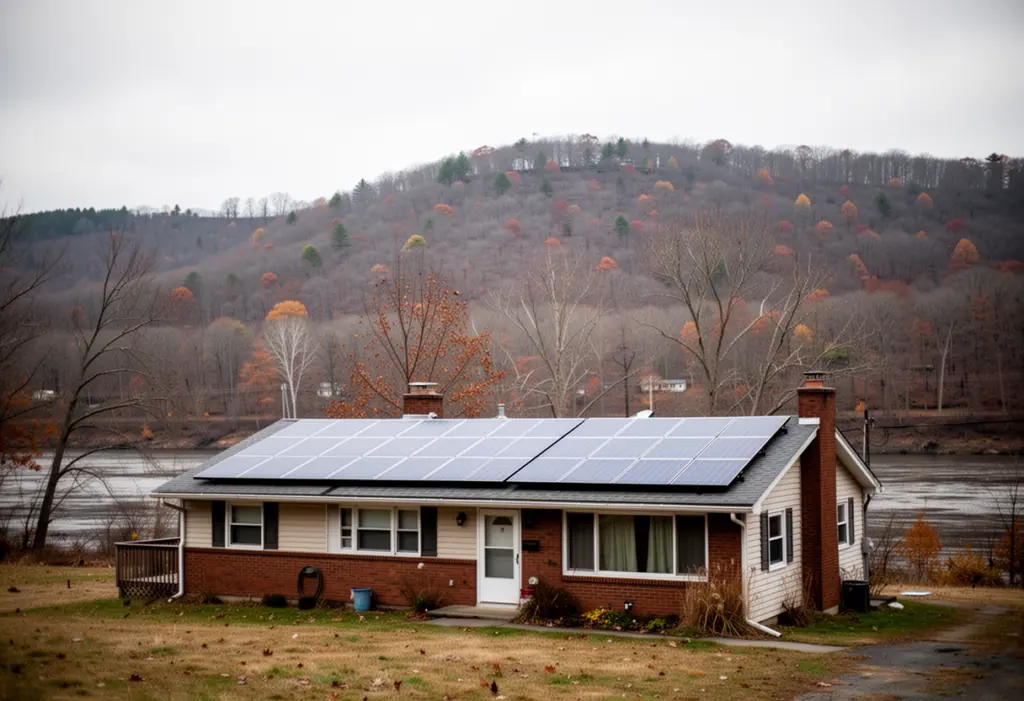
Vestal is a town in Broome County on the south bank of the Susquehanna, directly across the water from Endicott, Endwell and Johnson City. ZIP code 13850. Two features of the ground here decide more about an installation than anything in a general New York guide: the river flats, and the hillside behind them.
The flats are mapped flood plain, and that sets the equipment height
The northern edge of the town is low ground along the Susquehanna, and a good deal of it sits in mapped flood plain. Where it applies, the constraint lands on the balance of system rather than on the array:
- The inverter, the AC and DC disconnects and the production meter normally have to sit above a stated elevation, which can mean a different wall, a greater height, or an interior position instead of the convenient spot beside the meter.
- Storage is the sharpest version of it. A basement battery is frequently ruled out on these properties, even though the basement is the least costly, quietest and tidiest place to put one.
- There is no cheap second attempt. Equipment relocated after an inspection costs several times what siting it correctly in the first place would have.
Ask the Town of Vestal what elevation applies to your parcel before a designer starts work. An installer who mostly works on higher ground may never think to raise it.
The wooded slope to the south
Vestal rises away from the river to the south, and south is the direction an array needs. On the valley floor the ground behind a house can take the sun out of the sky earlier than a desk estimate suggests, and because the slope is close and wooded the effect changes sharply from one street to the next. Two houses a few hundred metres apart can have genuinely different southern horizons.
December is the month that decides it, when the sun sits lowest and the net metering credit bank is being drawn down. Insist on an on-site shading assessment rather than a satellite estimate, and ask what the model says about December and January specifically rather than only the annual total. Where two quotes differ substantially on production for the same array size, one of them has usually not visited the property.
One permitting authority, which is unusual around here
Vestal contains no incorporated village, so the Town of Vestal is the permitting authority across the whole town. That is simpler than the north bank, where Endicott and Johnson City are villages running their own building departments inside the Town of Union. Ask what the town requires and how long it is currently taking to turn a file around, and whether it processes solar under the NYS Unified Solar Permit, which standardises the residential route for anything rated 25 kW DC or below.
NYSEG and the Customer Benefit Contribution
Most of Vestal is NYSEG territory. Its Customer Benefit Contribution falls on anyone who interconnected on or after 1 January 2022 and is calculated from the DC size of the array rather than from anything it generates. The 2026 residential rate is $1.19 per kW-month:
- A 9 kW system: $10.71 a month, about $129 a year.
- A 13 kW system: $15.47 a month, about $186 a year.
It is billed on capacity regardless of what the system produces, and recalculated annually rather than locked in at interconnection. Phase One net metering credits exported kilowatt-hours at the full retail rate and holds that structure for 20 years from interconnection, which is the arrangement most residential rooftop customers here are on.
Roofs and service panels
The usual gate applies: under roughly ten years of shingle life left means re-roof first, because removing and reinstalling an array later costs considerably more than mounting on a bare roof. Older housing in the town frequently has 100 amp service, where fitting a solar breaker can require a panel upgrade or a line-side tap. Ask what your service is and whether the busbar has room, and get the answer priced in the quote rather than raised as a change order after contract.
Read the utility name off your own bill
Most of Vestal is NYSEG, but territory lines in the Southern Tier do not follow town or village boundaries, and a mailing address is not evidence of anything. There is a second reason to look. A number of New York villages own and run their own municipal electric utilities, and a municipal customer sits outside Public Service Commission jurisdiction altogether: no state net metering, no Customer Benefit Contribution, no standardised state interconnection process. Terms in that case are whatever the utility sets, and the only way to learn them is to ask it directly. None of that is visible from a postcode, and an installer quoting from a desk will not check it for you.
2026 incentives, and the one that reaches a tenant
The 30% federal residential credit is gone. Section 25D was terminated for expenditures made after 31 December 2025, with an expenditure treated as made when the original installation is completed. Any 2026 proposal still showing a 30% federal line is materially wrong, and that is the first thing to check on a quote.
The incentive that matters most across a good part of Vestal is the one that does not involve a roof at all. The town carries a substantial rented housing stock, and there the meter decides everything: a system offsets only the meter it is connected behind. A landlord’s array offsets the landlord’s usage, not the tenant’s apartment, even where the panels sit directly above it. Community solar reaches whoever is paying the bill, needs no roof and no up-front cost, and its subscribers pay no Customer Benefit Contribution at all, because it is a front-of-the-meter arrangement. For a tenant, or an owner whose tenants hold their own meters, that is the whole list.
For an owner-occupier the rest still applies: the state’s 25% credit capped at $5,000 on Form IT-255, which requires a principal residence in New York, reaches leases and power purchase agreements of ten years or more, and is limited by your actual state tax liability; the state sales tax exemption, which in Broome County covers the local sales tax too (Tax Department Publication 718-S); and RPTL 487, a 15-year exemption on the added property value where the Town of Vestal, Broome County and your school district have each not opted out, for construction before 1 January 2030, provided you file form RP-487 with each assessor by the taxable status date. NY-Sun and its Affordable Solar blocks, which your contractor used to apply to the price, are no longer open for homes. As of September 2026 NYSERDA has no open NY-Sun block for homes in any utility territory; check NYSERDA’s NY-Sun dashboard for a new one. Confirm current terms with NYSERDA and the New York Department of Taxation and Finance before you sign anything.
Frequently Asked Questions
Does the Susquehanna flood plain affect a solar installation in Vestal?
On the low ground along the river, yes. The inverter, disconnects, production meter and any battery normally have to sit above a stated elevation, which usually rules the basement out for storage. Ask the town what elevation applies to your parcel before a design is drawn.
Why do two Vestal houses on the same street get different production estimates?
Usually the southern horizon. The town rises to the south in close wooded slopes, so the skyline in the direction the array needs varies sharply over short distances. Insist on an on-site assessment and ask what the model says about December and January.
What can a Vestal tenant or landlord actually use?
Community solar, in most cases. A rooftop system offsets only the meter it is connected behind, so a landlord's array does nothing for a tenant's bill. Community solar needs no roof, no up-front cost, and its subscribers pay no Customer Benefit Contribution.
What does NYSEG charge a Vestal solar customer?
The Customer Benefit Contribution at $1.19 per kW-month of DC system size for 2026: $10.71 a month on 9 kW, about $129 a year, and $15.47 on 13 kW, about $186. It follows capacity regardless of production and is recalculated annually.
This article is general information, not tax, legal or financial advice. Incentive amounts, eligibility rules and deadlines change and depend on your utility, your tax situation and your property. Confirm current terms with NYSERDA, your utility and a qualified tax professional before making a decision.
NY Solar Incentives
Independent New York solar research. We summarise NYSERDA, NY-Sun and federal programme rules from published sources and state plainly when a figure is an estimate. We are not a government agency and do not sell equipment.
Run the arithmetic on your own system
Check the dated program table and your arrangement before counting an incentive. Standard residential NY-Sun blocks are closed; Long Island Affordable Solar has a conditional income-verification route. The NY credit depends on qualified costs and tax liability, while the NYC abatement reduces future property-tax bills. The estimator keeps those timings separate.